Electric vehicles are becoming a fixture in Perth garages. With EV sales in Australia growing rapidly and home charging installations becoming one of our more common jobs, a question that comes up regularly is: do I need anything extra in my garage for fire or CO detection?
The short answer is yes, and the Ajax FireProtect 2 range handles it better than most people realise.
First, the Actual Risk: Without the Hype
EV fires get attention out of proportion to how often they actually happen. The data is worth understanding before making any decisions.
According to research by EV FireSafe, an organisation funded by the Australian Department of Defence to study EV battery fires, there have been 13 confirmed EV battery fires in Australia since 2021, against approximately 473,000 plug-in electric vehicles on Australian roads. That works out to about 3 in every 100,000, which is very low.
Petrol and diesel vehicles catch fire far more often. Nobody is suggesting you need special detection equipment for a conventional car in your garage.
So why does it still matter? Two reasons. First, the nature of a lithium-ion battery fire is different. It burns hotter and longer, and releases toxic gases including carbon monoxide and hydrogen fluoride in an enclosed space like a garage. Second, an attached garage is usually connected to your home. Detection time matters enormously.
What Fire Authorities Actually Recommend
Fire and Rescue NSW, whose guidelines are widely referenced across Australian states, formally recommends that a smoke alarm or heat alarm be installed in private garages where an EV is regularly parked or charged. This is an official recommendation, not a suggestion from a product manufacturer.
For Western Australia, the same principle applies under the Building Code of Australia requirements for smoke alarms. An attached garage connected to a dwelling creates a fire pathway into the home, and many homes still have no detection in that space at all.
Why Standard Standalone Smoke Alarms Fall Short
The $25 ionisation smoke alarm from a hardware store does one thing: it beeps loudly when it detects smoke. In a garage, that means:
- You have to be home and awake to hear it
- It gives no warning if you are asleep upstairs with the bedroom door closed
- It detects smoke, but not the heat from a fire that has not started producing smoke yet
- It does not detect carbon monoxide, a colourless, odourless gas that can incapacitate you before you smell anything
- It has no way to alert your phone if you are away while your EV charges overnight
If your EV charges overnight, which is when most people charge because off-peak power is cheaper, you are asleep while the highest-risk period is occurring.
Ajax FireProtect 2: What It Actually Does
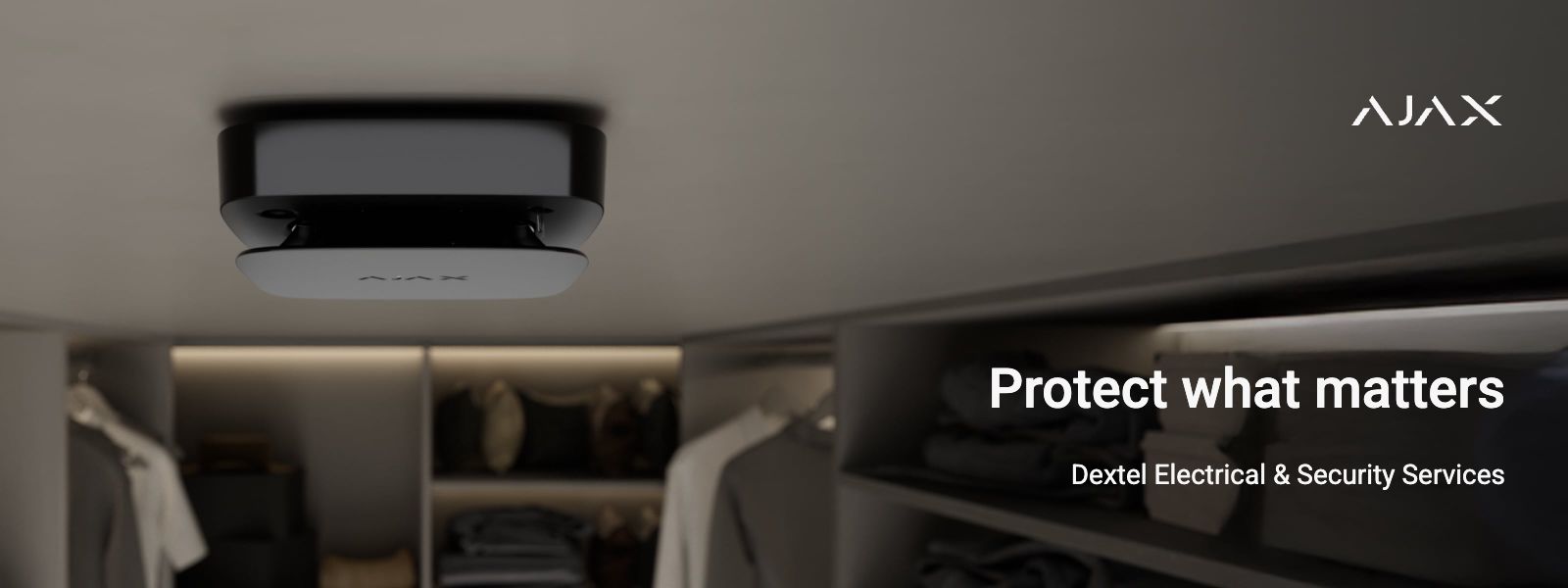
The Ajax FireProtect 2 range is the fire and life safety component of the Ajax security ecosystem. There are two main variants relevant to a garage or home installation:
FireProtect 2 (Heat/Smoke): detects both smoke and heat. The dual-spectrum optical sensor uses Ajax's HazeFlow 2 algorithm, which tells real smoke from steam or dust, which cuts down false alarms. The thermistor heat sensor catches smokeless fires such as those that start with synthetic materials or electrical components smouldering before producing visible smoke.
FireProtect 2 (Heat/Smoke/CO): adds a carbon monoxide sensor to the above. For any enclosed space where combustion can happen, like a garage, a room with a gas appliance, or anywhere an EV is stored, this is the version to consider.
Both versions are fully wireless, battery-powered (with mains-powered versions also available), and integrate directly into the Ajax security system you may already have. They connect to the Ajax hub over Jeweller radio, the same encrypted 868MHz connection used by your alarm sensors.
What Happens When It Triggers
This is where the difference from a standalone alarm becomes significant.
When an Ajax FireProtect 2 detects smoke, heat, or CO, Ajax says it sends an alarm to the hub within 20 seconds. The hub then does several things simultaneously:
- Activates the built-in 85dB siren on the detector itself
- Triggers interconnected alarms on every other FireProtect 2 device in your home simultaneously
- Sends an instant push notification to your phone through the Ajax app, with the exact location of the triggering device, the type of alarm (smoke, heat, or CO), and the time
- Notifies your security monitoring company if you have one connected
That last point matters for the overnight charging scenario. If something starts in the garage at 2am, you get a phone alert before things have time to develop, whether you are asleep upstairs or away for the weekend. Pairing this with CCTV coverage of the garage gives you visual confirmation alongside the alert.
CO Detection and Why It Matters Beyond EVs
Carbon monoxide is not only an EV risk. It comes from any incomplete combustion: a petrol car left running briefly in an enclosed garage, a gas hot water system near a garage, a faulty gas appliance, or a petrol generator. CO is colourless and odourless, and the symptoms of poisoning (headache, dizziness, confusion) look like flu, which means people often do not identify the cause in time.
The FireProtect 2 CO sensor begins alerting at 50 parts per million, with escalating alarm thresholds as concentration rises. At 300ppm, a dangerous level, it triggers within 3 minutes.
For Perth homes with gas appliances, this is relevant regardless of whether you own an EV. It is one of many things we check as part of our broader electrical services across Perth.
Fitting Into Your Existing Ajax System
If you already have an Ajax alarm system installed by Dextel, adding FireProtect 2 detectors is straightforward. They pair directly to your existing hub through the Ajax app, with no rewiring and no new hub. They appear alongside your motion sensors and door contacts in the same interface, and trigger the same notification system.
If you do not have an Ajax system yet, a combined security and fire detection system is worth considering as a single installation. A hub, a few alarm sensors, and two or three FireProtect 2 devices covering the garage, hallway, and main living areas gives you comprehensive coverage in one job. Our Ajax alarm systems page covers the full hub and sensor range if you are starting from scratch, and FireProtect 2 can be added to any of our installed Ajax packages at a published price.
Practical Recommendation for Perth EV Owners
If your EV charges in an attached garage overnight, at minimum we would suggest a FireProtect 2 (Heat/Smoke/CO) in the garage and a FireProtect 2 (Heat/Smoke) in the hallway connecting the garage to the rest of the house. This covers the origin point and the fire pathway.
If you already have standalone smoke alarms in your home, those can remain in place alongside the Ajax devices. They do not conflict. The Ajax devices add the phone notification layer and CO detection that standalone alarms cannot provide.
As with any security or safety installation, we assess your specific property and give you an honest recommendation on coverage. There is no one-size-fits-all answer. A double garage attached to a large home has different requirements than a single garage on a small block. If the garage has an EV charger, see EV charger installation, and Ajax vs Wi-Fi alarms for how the system connects.
Need Help With This?
Dextel Electrical & Security Services serves Perth metro. Free quotes, no obligation.
Get a Free Quote →