Most business owners think about their electrical system the way they think about plumbing: something that works until it does not. Commercial electrical compliance does not work that way. There are specific, recurring legal obligations that apply whether or not anything has gone wrong yet.
Three areas come up constantly for Perth businesses: RCD testing, emergency and exit lighting, and switchboard load capacity. This is what each one actually requires.
RCD Testing: What WA Actually Requires
In Western Australia, RCDs used at a workplace must be tested regularly by a competent person (WorkSafe WA). How often is a decision for the business, based on a risk assessment of the equipment and the environment, and AS/NZS 3760 sets out the usual testing schedules.
AS/NZS 3760:2022 is the technical standard underpinning this across Australia, and it specifies two distinct types of check:
- Push-button test: confirms the RCD physically trips when the test button is pressed. This is a basic functional check and can often be done more frequently by trained staff as part of routine checks
- Trip-time test: measures how quickly the RCD actually cuts power under a simulated fault condition, confirming it disconnects within the time required to prevent injury. This test needs proper test equipment, and WorkSafe WA says it is done by a licensed electrician or a person trained and assessed in using an RCD tester
Testing frequency really depends on the risk level of the environment. Office and retail environments are generally lower risk and may only require annual testing. Higher-risk environments, like workshops, areas with moisture or dust, and sites near construction, typically require more frequent testing, sometimes every three to six months. There is no single number that applies to every commercial property; it depends on a documented risk assessment of how the equipment and circuits are actually used.
Records matter as much as the testing itself. WorkSafe WA requires a record of testing to be kept until the device is next tested, and AS/NZS 3760:2022 sets out what the record holds (the date, the result and who did it). If your business is ever audited or inspected following an incident, this documentation is what proves you met your obligations. No records effectively means no proof of compliance, even if the testing really happened.
Emergency and Exit Lighting: AS/NZS 2293.2
Every commercial building with emergency escape lighting and exit signs is required to maintain them under AS/NZS 2293.2:2019, the maintenance and testing part of the broader AS/NZS 2293 series referenced directly in the National Construction Code. This is not a recommendation; it is a legal obligation with real testing intervals and serious consequences for skipping it. Our commercial lighting service covers installation and the six-monthly testing.
The required testing schedule under AS/NZS 2293.2:2019 has two layers:
- Six-monthly: the headline requirement: a 90-minute battery discharge test, simulating a full mains power failure and confirming every emergency light and exit sign remains illuminated for the entire duration. Any fitting that fails this test must be repaired or replaced, with the failure and the fix both documented
- Annual: a full inspection and clean of every fitting and reflective surface, checking for damage, obstruction, or anything that would reduce visibility along an escape route
Switchboard Load Capacity and Load Management
The third area is less about a fixed testing interval and more about a question that catches businesses out repeatedly: does your switchboard actually have the capacity for what you are asking it to do?
Every commercial electrical installation has a calculated maximum demand: the realistic peak current the installation is expected to draw, calculated under AS/NZS 3000 Appendix C using diversity factors specific to different load types. This is not simply adding up the nameplate rating of every piece of equipment in the building; it is a proper calculation accounting for how loads actually behave together. Get it wrong and you either pay for far more supply capacity than you will ever use, or you trip the main switch on the one hot day when the air conditioning, the kitchen equipment, and a full office are all running at once.
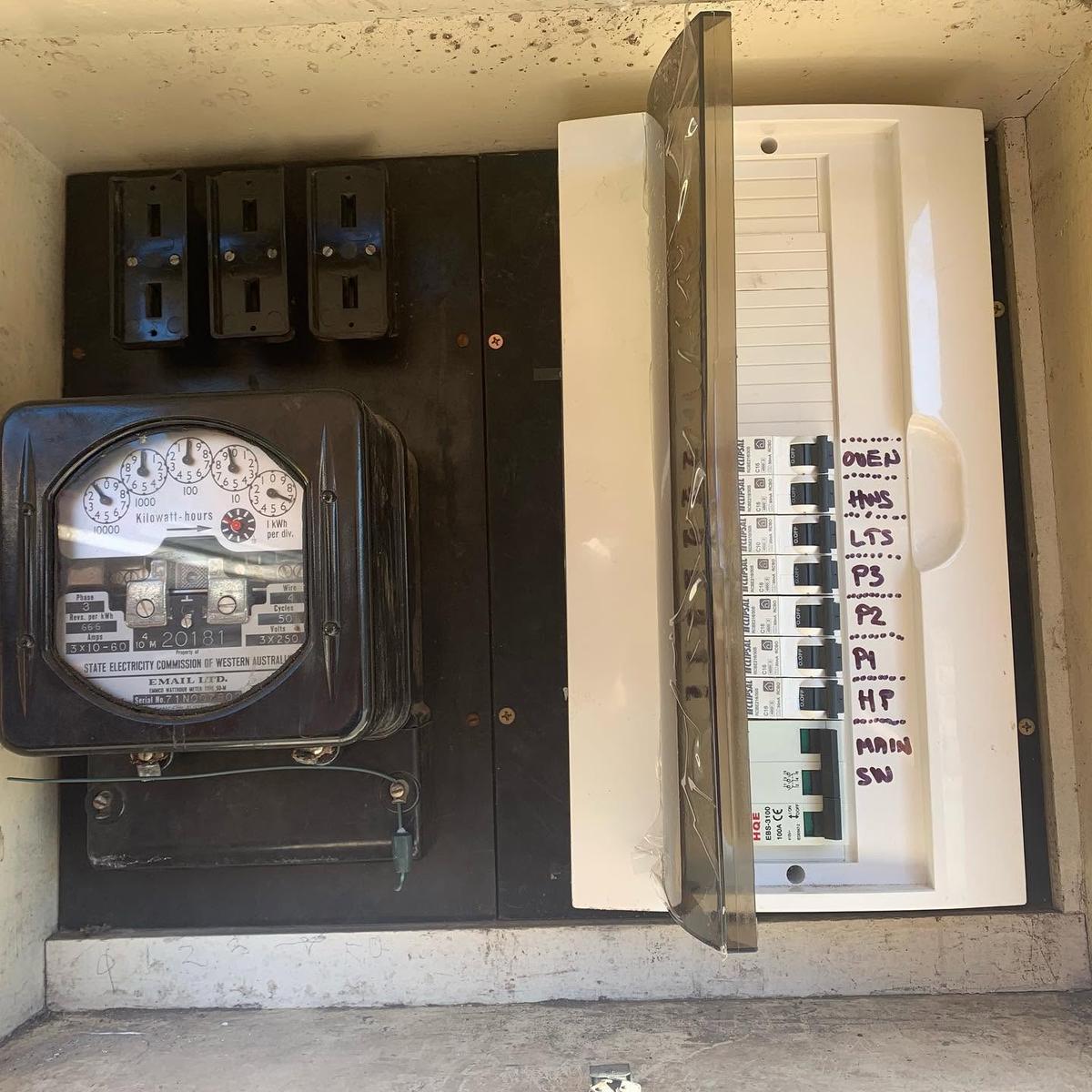
The problem we see most often in Perth commercial properties is the same one that comes up across the industry: a switchboard that was adequate when installed becomes inadequate as a business grows. New equipment, an EV charger, additional lighting circuits, a kitchen fitout, expanded office space. Each addition seems minor on its own, but together they push the installation past what the original switchboard and supply were sized for. The result is exactly what AS/NZS 3000 is designed to prevent: overloaded circuits, frequent nuisance tripping, and in the worst cases, genuine fire risk from a board running hotter than it was ever designed to handle.
Load management in practice means understanding what your switchboard can actually support, and making deliberate decisions about how load is distributed rather than just adding circuits until something trips. For a commercial property this typically involves:
- A proper maximum demand calculation reflecting current equipment and realistic future additions, not just current usage
- Adequate spare capacity in the switchboard for circuits you will likely add in the next few years, rather than designing right up to the current limit
- Correct circuit discrimination, so a fault in one tenancy, office, or piece of equipment trips only the relevant breaker rather than taking down the whole building
If your business has grown since the switchboard was last assessed, or you are planning equipment additions, solar, battery storage, or EV charging, this is exactly the point to get a proper load assessment done: before the addition, not after it causes a problem. Our old fuse box guide covers what a modern, properly specified board includes for residential properties, and the same underlying principles of adequate capacity and proper RCD protection apply at commercial scale, just with higher loads and three-phase considerations.
Bringing It Together
RCD testing, emergency lighting compliance, and load management are three separate obligations, but they tend to surface together in the same conversation, usually when a business is being audited, expanding, or dealing with a property transaction. The businesses that handle this well treat it as an ongoing maintenance schedule rather than a once-off box to tick. A structured annual review covering all three areas, with proper documentation kept along the way, is the difference between walking into an audit with confidence and scrambling to catch up after something has already gone wrong.
If you are not sure where your commercial property currently stands on RCD testing, emergency lighting compliance, or switchboard capacity, we can carry out a proper assessment and tell you exactly what is required, what is already compliant, and what needs attention, with the documentation to back it up. For tenancy work see shop and office fit-outs.
Need a Commercial Electrical Assessment?
Tell us about your site, planned works or maintenance concern. Dextel can help clarify the practical next step for electrical, data and integrated security work.
Discuss Your Site → Commercial electrical services →