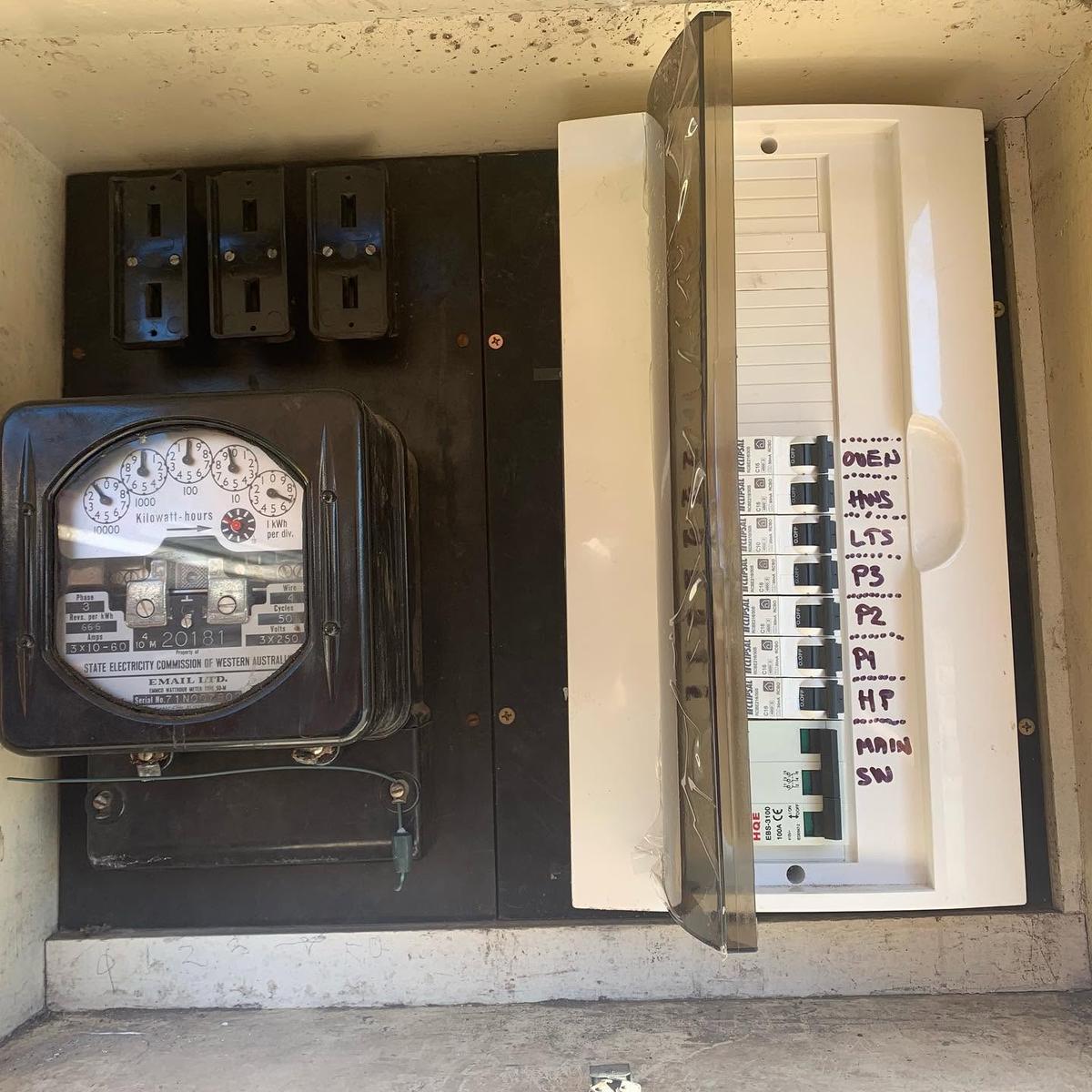
Most Perth homeowners do not think about their switchboard until something trips. And most switchboards in homes built before the mid-1990s were not designed for the electrical load, safety requirements, or appliance mix of a modern household.
If your home still has ceramic fuses (the kind you replace with fuse wire when they blow) or an older switchboard where not every circuit has an RCD protecting it, you have a safety and compliance issue worth understanding. This guide covers the signs, what the rules say and when it is time to replace the board. If you already know you want it done, the switchboard upgrade service page has what the job includes.
What Is in Your Switchboard
A domestic switchboard contains the devices that control and protect every electrical circuit in your home. A modern compliant switchboard contains three types of protective device:
The main switch: isolates the entire installation from the supply. Turns everything off at once for safe access to the switchboard or when leaving the property for extended periods.
Circuit breakers: protect the wiring in each circuit from overload and short circuit. If more current flows than the cable can safely carry, the breaker trips and cuts power to that circuit. This protects the wiring from overheating and potentially causing a fire inside the wall.
RCDs (Residual Current Devices): protect people from electric shock. An RCD monitors the current flowing out on the active wire and returning on the neutral wire. If it detects a difference (current leaking to earth through a person, a fault, or water), it disconnects the power in a fraction of a second, once the leakage reaches about 30 milliamps. That speed is what makes an RCD effective at reducing the risk of a fatal electric shock.
Circuit breakers and RCDs do completely different jobs. A circuit breaker does not protect against electric shock. It only protects the wiring. An RCD does not protect against overload. It only protects against earth leakage. A properly upgraded switchboard has both on every circuit. If your RCD has been tripping recently, our guide to troubleshooting a tripped RCD covers what to check before calling us.
What Old Switchboards Are Missing
Perth homes built before the late 1990s typically fall into one of these situations:
Ceramic fuse switchboards: the oldest type, still found in pre-1980s Perth homes. Individual ceramic fuse holders contain fuse wire that melts when a circuit overloads. No RCDs, no circuit breakers, no earth leakage protection whatsoever. These do not meet current Australian Standards for residential installations and have not for some time.
Early circuit breaker boards without RCDs: an improvement over fuses but incomplete. The circuit breakers protect the wiring but with no RCD protection, there is nothing to disconnect power if someone contacts a live part. Common in homes built through the 1980s and early 1990s.
Partial RCD protection: boards that have RCDs on some circuits but not all. Power and lighting circuits without RCD protection are a compliance gap under current WA requirements. Common in homes that had partial electrical work done over the years without a full board upgrade.
How Many RCDs Do You Need? What WA Regulations Require
Under AS/NZS 3000:2018 as adopted in WA, the requirement for domestic and residential installations is clear: every final sub-circuit must be protected by a 30mA RCD in new residential installations built from 1 January 2019. This is not limited to socket outlets and lighting. It covers all final sub-circuits including hard-wired appliance circuits such as air conditioners, ovens, and hot water systems (Building and Energy).
Separately, the Electricity Regulations 1947 set a minimum for homes that are being sold, rented or hired. Before the title transfers, the home must have:
- At least two RCDs protecting all socket outlet and lighting final sub-circuits
- No more than three final sub-circuits per RCD
- Where there are two or more lighting circuits, the lighting circuits divided between the RCDs
That sale and rental rule does not itself require RCDs on hard-wired appliance circuits. The source is the WA Government RCD page.
The minimum of two RCDs is a floor, not a ceiling. It exists to ensure that a single RCD failure or trip does not remove protection from the entire installation simultaneously. In a typical Perth home with many circuits, you will have considerably more than two RCDs or individual RCBOs.
The modification trigger: The full RCD requirement applies not only to new builds but also when a switchboard is altered or replaced. When we alter or add to a switchboard, it has to be brought up to current standards, including RCD protection on the final sub-circuits it supplies. The exception is a like-for-like replacement, such as swapping a faulty RCD or circuit breaker for the same type. This means a switchboard upgrade brings the obligation to protect every circuit, including any hard-wired appliance circuits that may not have had RCD protection previously.
The requirement applies as follows:
- New homes: full RCD protection on all final sub-circuits is mandatory, including hard-wired appliances
- New electrical work or additional circuits: new sub-circuits must include RCD protection
- Switchboard upgrade or modification: all circuits must be brought to current standards at the time of the upgrade, including existing hard-wired appliance circuits. A like-for-like replacement of a faulty RCD or circuit breaker is the exception
- Property sale or lease: the Electricity Regulations require at least two RCDs before the title transfers (see above). WA does not require a full switchboard upgrade at sale
The practical implication: if you have had electrical work done on your home in recent years and the electrician did not mention your switchboard, the new circuits may be compliant but the old circuits may still lack RCD protection. A full switchboard assessment tells you exactly where you stand.
RCD Types: Why AC vs Type A Matters Now
Not all RCDs are the same, and the difference has become critical in recent years.
AC type RCDs detect sinusoidal (pure AC) earth leakage current: the type produced by simple resistive loads like old heaters and basic appliances. They were the standard in Australian switchboards for decades. However, AC type RCDs and RCBOs cannot be installed in new work in Australia from 1 May 2023 (AS/NZS 3000:2018 clause 2.6.2.2.2 as amended, per Building and Energy). If you have AC type devices in an existing board, they are not required to be immediately replaced. Existing installations with AC type protection are permitted to remain. But they are no longer considered adequate protection for the appliances found in modern homes, and replacement with Type A is recommended.
Type A RCDs detect both sinusoidal AC leakage and pulsating DC leakage. This is the type now required for all new installations and switchboard upgrades in Australia. The reason this matters is straightforward: modern appliances with electronic control boards (inverter air conditioners, variable speed pool pumps, EV chargers, washing machines with inverter motors, solar inverters, and most modern white goods) produce pulsating DC leakage current when they develop a fault. An AC type RCD may not detect this reliably, meaning the protection you think you have may not actually operate in the fault condition that is most likely to occur with a modern appliance.
The practical rule is simple:
- Existing homes with AC type RCDs: compliant to remain as-is, but replacement with Type A is recommended, particularly on circuits supplying inverter appliances or EV chargers
- Any new switchboard upgrade or modification: Type A RCDs or Type A RCBOs must be fitted. AC type is not permitted for the new installation
- New circuits added to an existing board: Type A required on the new protection devices
When we carry out a switchboard upgrade, we specify Type A devices throughout as standard. The cost difference over AC type is modest, and fitting the correct type from the outset avoids any question about compliance or protection adequacy.
RCD vs RCBO: Which Is Better?
There are two ways to provide RCD protection across a switchboard, and the difference is worth understanding before deciding on an upgrade.
Standard configuration: one RCD protecting multiple circuits: A single RCD sits in the board and has several circuit breakers connected behind it, each protecting an individual circuit. This meets the compliance requirement and is the minimum standard approach. The significant drawback is fault discrimination. If one circuit develops an earth leakage fault and trips the RCD, every circuit behind that RCD loses power simultaneously. A dripping outdoor light fitting trips the RCD and takes out every other circuit it shares: potentially the fridge, the alarm system, the internet router, and several rooms of lighting at once.
RCBO configuration: one RCBO per circuit: An RCBO (Residual Current Breaker with Overcurrent) is a combined RCD and circuit breaker in a single device. One RCBO per circuit means each circuit has its own independent RCD and overcurrent protection. If a fault develops on one circuit, that circuit trips. Everything else in the house stays on. You lose one power point or one light, not half the house.
The practical benefits of individual RCBOs:
- Fault isolation: a fault on any single circuit affects only that circuit. The rest of the house is unaffected
- Faster fault finding: the tripped RCBO tells you exactly which circuit has the problem. No guesswork, no systematically switching off groups of circuits to isolate the fault
- No shared failure risk: an RCD that fails or wears out mechanically takes down every circuit behind it. An RCBO failure affects only one circuit
- Cleaner switchboard layout: one device per circuit, clearly labelled, easy to read and operate
- Better for modern homes: with multiple sensitive appliances across multiple circuits, the ability to isolate a single fault without disrupting anything else is a significant quality-of-life advantage
RCBOs cost more per circuit than a shared RCD and circuit breaker combination. For a full house upgrade the difference is real but not dramatic relative to the total job cost, and over the life of the installation the fault discrimination benefit alone is worth it. For a Perth home where an unexplained RCD trip at 2am currently means walking to the switchboard and guessing which of eight circuits behind one RCD has the problem, the upgrade pays for itself in convenience fairly quickly.
For new switchboard upgrades we recommend individual RCBOs per circuit as the standard approach. We will always explain both options and let you make the decision with full information.
The Real-World Consequences of an Old Board
Beyond compliance, older switchboards have practical limitations that affect daily life:
Capacity. A 1970s home was designed for a fraction of the electrical load a modern Perth household draws. Air conditioning, EV charging, induction cooktops, multiple computers, home theatre systems: the total load of a modern home can exceed what an old board was designed to distribute safely. Circuits that trip frequently under normal use are often a capacity issue, not a fault.
Planning an EV charger? See whether your home can handle an EV charger.
Inability to add circuits. Adding a dedicated circuit for an EV charger, air conditioner, pool pump, or home office requires space in the switchboard and a compliant board to connect to. An old fuse board cannot accommodate new circuit breakers of the type required by modern standards. A switchboard upgrade is a prerequisite for many common additions.
While you are upgrading, it is also worth considering whole-home surge protection. It fits into the same switchboard and is often done in the same visit.
What a Modern Switchboard Upgrade Includes
A full domestic switchboard upgrade typically involves:
- Removal of the existing board and all fuses or old circuit breakers
- Supply and installation of a new DIN-rail enclosure sized appropriately for the number of circuits
- Installation of a main isolating switch
- Installation of RCDs: minimum two required under WA regulations, configured to protect all final sub-circuits
- Installation of individual circuit breakers for each circuit, sized to match the cable rating
- Labelling of all circuits clearly and accurately
- Testing and verification of all RCDs and circuit breakers
- Electrical Safety Certificate and notice of completion, lodged online through Building and Energy's eNotice system
The Electrical Safety Certificate is an important document. It is the legal record, lodged online through Building and Energy's eNotice system, that the work was carried out by a licensed electrical contractor to the required standard. Keep a copy with your home records.
For notifiable electrical work the paperwork follows a set order, all lodged online through eNotice: the preliminary notice before the work starts, the notice of completion once it is finished, and then the Electrical Safety Certificate.
How Long Does a Switchboard Upgrade Take, and What Does It Cost?
A standard domestic switchboard upgrade in a Perth home typically takes four to six hours for a single electrician. Larger homes with more circuits take longer. Power to the house is off for the duration of the work. We schedule these jobs to minimise disruption and give you a realistic time estimate beforehand.
If your board only needs RCDs added rather than a full upgrade, see RCD safety switch installation. If the board is mounted on an old black panel, the panel may contain asbestos, which changes how the job is done: see asbestos switchboards.
Cost depends on the number of circuits, the chosen configuration (RCDs vs RCBOs), whether the existing enclosure can be reused, and access. A typical domestic switchboard upgrade costs $1,500 to $3,000 including GST. Where yours sits in that range depends on the board, so we price each one after looking at it. We provide a fixed price quote before starting. No surprises on completion.
If your home has an old fuse board, partial RCD protection, or a switchboard that has not been assessed in many years, it is worth having us take a look. The assessment is free and will tell you exactly what you have, what you need, and what it will cost to get there. This is one of the many electrical services we provide across Perth metro. See our switchboard upgrade service for what is included and how to book.
Need a switchboard upgrade?
See a recent Spearwood upgrade from a mixed legacy board to a new enclosure with RCBO protection, or request a free assessment for your property.
View Spearwood Upgrade →