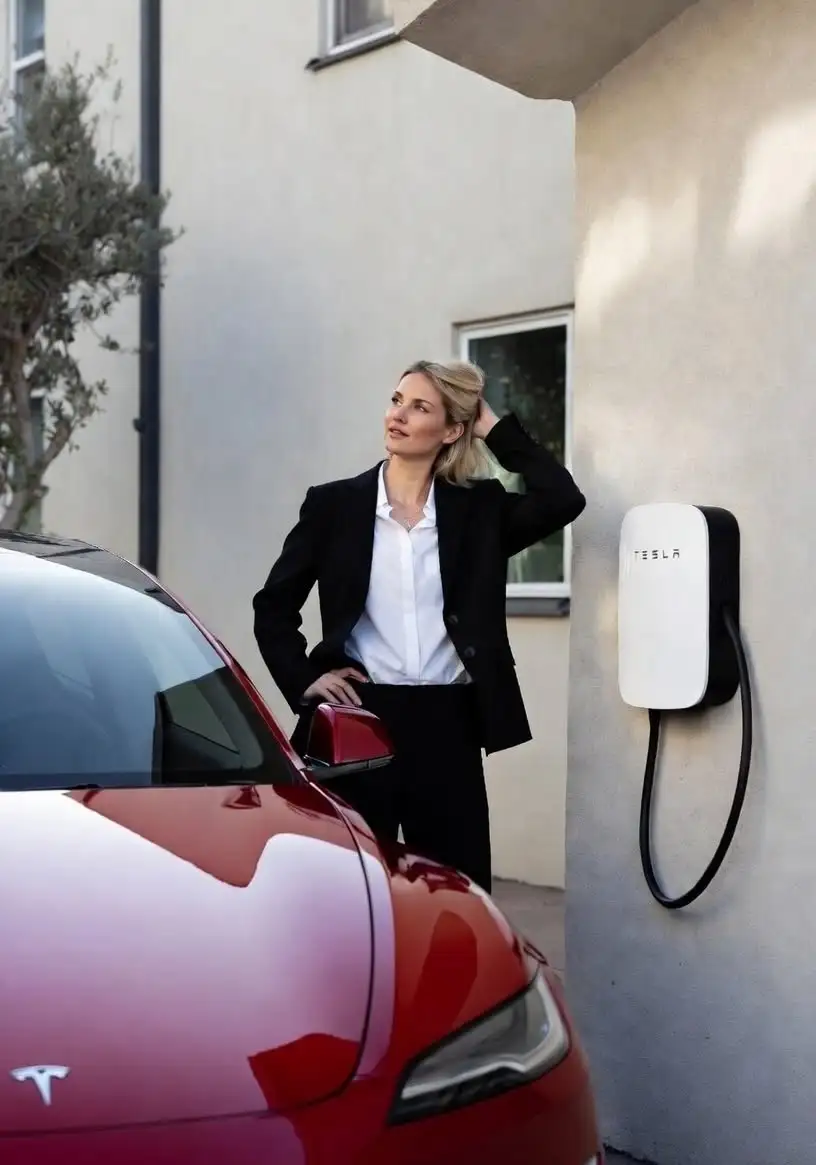
Before you choose an EV charger, the question to answer is whether your home can supply one. The charger is the easy part. The main switch, the spare capacity in your switchboard and the type of RCD decide what can be fitted, and in an older Perth home they can decide the cost. This guide covers what to check first, the WA rules that apply, and what a licensed electrician looks at. If you want it done, Dextel installs these as part of its EV charger installation service.
Below: what a home charging setup needs, whether your switchboard can take the load, the WA main switch rule, what the wiring rules require, where to put the charger, and what the installation looks like on the day.
What a Home EV Charging Setup Needs
At a basic level, charging an EV at home requires four things working together: a charger compatible with your vehicle and how you drive, a charging cable of suitable length for where you park, a power supply with enough spare capacity for the type of charger you choose, and a dedicated, off-street spot to charge from, almost always a garage or carport.
The piece most people overlook is the third one. A charger is only as good as the electrical supply behind it, which is why the first real step is not choosing a charger at all. It is finding out what your switchboard can actually support.
Does Your Home Need an Electrical Upgrade First?
Before anything else, a licensed electrician needs to confirm your switchboard has the capacity for an EV charging circuit. Older homes in particular may have wiring or a main switch that was never designed for the kind of sustained, high-current load an EV charger places on the system. Charging without enough capacity is more than inconvenient. An overloaded circuit is a real fire and shock hazard.
If you want to get a rough sense of what you are dealing with before an electrician even arrives, open your switchboard and count how many poles the main switch occupies. One pole typically means a single-phase supply; three poles together means you already have three-phase running to the property. Either way, your EV will charge. Three-phase just opens up faster charging if the vehicle itself is built to take advantage of it.
If your home does not already have enough spare capacity, an electrician will typically update the wiring, install the correct circuit breaker, and carry out whatever switchboard work is needed before the charger itself goes in. In some cases, particularly where many large appliances already compete for capacity, a load management solution is a smarter and cheaper fix than a full switchboard upgrade (more on that below).
The WA Rule That Catches Most People Out: Your Main Switch
This is the part that surprises most homeowners, so it is worth explaining properly.
Under the Western Australian Service and Installation Requirements (WASIR), a standard residential connection in metro Perth is allocated a fixed amount of power from the network: 63A on single-phase, or 32A per phase on three-phase. This is not a recommendation; it is the actual capacity your property is entitled to draw under a standard connection (Western Power).
To enforce this limit, WASIR requires the main switch to be a circuit breaker when a connection is altered, and Western Power states that for EV charging connections the main switch must be upgraded to a circuit breaker. In practice that means replacing the existing main switch with a 63A circuit breaker on single-phase, or 32A on three-phase, as part of the installation.
If your total calculated demand, including the new EV charger, would exceed your standard allocation, a circuit breaker upgrade alone does not solve the underlying problem. In that case, you would need to apply to Western Power for an actual supply upgrade. This is exactly why a proper electrician calculates your maximum demand proportionately before quoting, rather than assuming a charger will simply fit.
What AS/NZS 3000 Requires
Beyond the main switch, the Australian and New Zealand Wiring Rules (AS/NZS 3000:2018) set out the specific technical requirements every EV charger installation must meet. In plain terms, this means:
- The work must be completed by a licensed electrician. It is not DIY work
- Every EV charger must be on its own dedicated circuit, with nothing else wired to it
- The charger runs from its own dedicated circuit back to the switchboard, whether it is a charger with its own cable or a charging cable with a plug that goes into a socket installed for that purpose
- Each charger requires its own circuit breaker sized correctly for the load
- The circuit must be protected by an RCD (safety switch): for most installations a Type A RCD at minimum, sometimes a Type B depending on the charger's own DC leakage detection
- Cable sizing must comply with AS/NZS 3008.1.1, accounting for the run length, the load, and the installation environment
None of this is yours to manage. A licensed electrician handles all of it as a matter of course. It is simply useful to know what happens behind the scenes, and why a compliant installation involves more than just screwing a box to the wall.
Choosing the Right Charger for Your Home
Most chargers on the market work with any EV brand, so the real decision comes down to your driving habits, your home setup and your budget, not the badge on the charger.
At the entry level, a charger that runs from a standard household outlet will trickle-charge your car overnight. That is fine if your daily driving is modest and you really do have all night to charge, but not something most homeowners stick with once they've experienced the alternative.
The step up, a unit wired into a dedicated circuit on your switchboard, is where most Perth households land. It needs a dedicated circuit installed by a licensed electrician, whether you choose a charger with its own cable or a charging cable that plugs into a socket on that circuit, but the charging speed difference is substantial enough that it pays for the install cost in convenience alone, particularly if you are covering real distance day to day.
Beyond that sits DC fast-charging equipment, the kind found at public charging stations and commercial sites. The electrical infrastructure required is well outside what a typical home connection can support, and it is not something you would realistically install at a private residence.
Choosing Where to Install It
Once the electrical side is sorted, where the charger actually goes matters more than most people expect, and it is worth thinking through properly before anyone starts drilling holes.
Start with how you actually use the space. If you always park in the same spot, like a garage bay or one side of a carport, that's almost always the right place to mount the charger, but check which side your EV's charging port sits on first, since reversing in versus driving in changes which wall the cable needs to reach. Distance from your switchboard matters too: a longer cable run adds cost, and you want to confirm the charger's own cable length will comfortably reach the car without stretching or tugging at the connector every time you plug in.
Practical mounting comes next: a solid wall or post to fix the unit to, enough clearance around it that nobody trips over the cable walking past, and weather exposure if it's going somewhere open to the elements, in which case you need a unit rated for outdoor installation rather than an indoor-only model. If you're keen on app-based scheduling or monitoring, it's worth checking your WiFi signal reaches the spot before committing. A weak connection there defeats the purpose of a smart charger.
Permits and Approvals in WA
For a standalone house, you generally do not need council approval to install a home EV charger. The two situations where approval really matters are strata properties, where you will need sign-off from the strata council (see the WA Government guide to charging in strata buildings), and non-metro regional areas, where approval from the relevant network operator (Horizon Power outside the Western Power network) may be required.
How the Installation Runs
In practice, a home EV charger installation runs through three stages. First, an assessment: a licensed electrician inspects your switchboard, confirms available capacity, and identifies whether any upgrade work is needed before quoting. Second, planning: working through the location questions above, confirming the right charger for your situation, and agreeing a fixed price before anything is booked in. Third, the installation itself: wiring updates if required, the dedicated circuit, the charger mounted and connected, and full testing before handover. The EV charger installation page covers how Dextel handles each step.
Charging with Solar
If you already have, or are planning, a home solar system, your EV charger can run from it directly. A correctly sized solar system lets you charge from your own panels during the day instead of the grid, and adding a home battery extends that into the evening. If solar charging is something you want, mention it up front so the charger chosen has the smart, app-connected features to make use of it. Not every charger does this equally well.
What Drives the Cost
The real total cost depends on several things at once: the charger itself, the amount of cable run, whether your switchboard needs any upgrade work, and whether you are going single or three-phase. Be cautious of advertised 'from' prices online; most of these refer to labour and installation materials only, not the charger hardware, which is typically a separate cost on top. The only way to know your real total is a proper quote that states clearly what is and is not included, which is what a site assessment is for.
If you are ready to get your home set up for EV charging, the right first step is a proper switchboard assessment, not picking a charger off a website and hoping it fits. I'm happy to talk through what your property can support before you commit to anything, and the EV charger installation page has what the job includes. If the board needs work first, read why an old fuse box is a risk, and for fire detection in the garage see Ajax detectors for EV garages.
Need Help With This?
Dextel Electrical & Security Services serves Perth metro. Free quotes, no obligation.
Get a Free Quote →