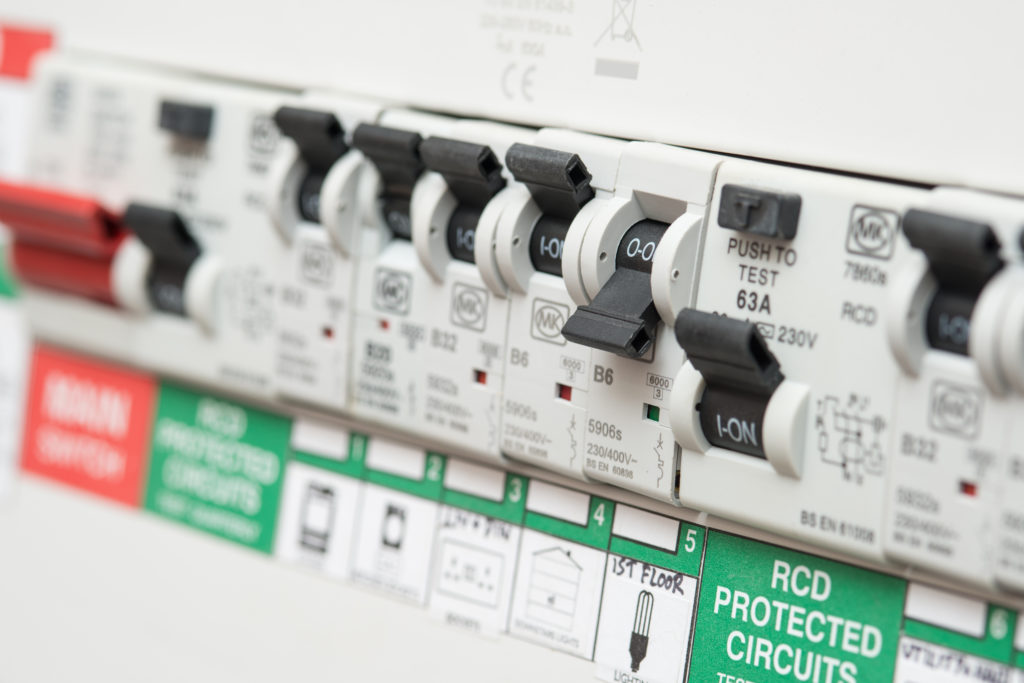
It is 7pm on a Sunday. Half the house has no power. You go to the switchboard and see an RCD switch sitting halfway between on and off, or fully tripped down. You push it back up, and it trips again straight away. Or it stays on, but the power is still out.
This is a common electrical fault. In many cases, safely isolating appliances or a circuit helps identify what has caused the trip. In others, a licensed electrician needs to test the fixed wiring or equipment.
This is the same process we go through with clients, written out so you can try it yourself.
First: What Is a Safety Switch (RCD) and Why Does It Trip?
An RCD (Residual Current Device) is the safety switch on your switchboard, the one with the test button on it. Its job is to detect current leaking to earth, which happens when electricity is going somewhere it should not: through a faulty appliance, water in a fitting, or a person.
Need RCDs added, replaced or tested? See RCD safety switch installation in Perth.
When it detects this leakage, it cuts power in a fraction of a second. This is exactly what it is designed to do. A tripping RCD usually is not faulty. It is doing its job because something on that circuit has a problem. If you would like the full picture on how your residential electrical system should be protected, our switchboard upgrade page covers it in more detail.
There are two common scenarios:
- No power to power points: the RCD protecting your power circuit has tripped
- No lights: the RCD protecting your lighting circuit has tripped
In both cases the way to find the cause is the same: rule things out one at a time.
Step 1: Go to Your Switchboard
Your switchboard is usually in the garage, a hallway, or on an external wall. Open the cover and look for the switches. You will see:
- Circuit breakers: labelled things like Lights, Power, Stove, AC. These are the narrow switches
- RCDs (safety switches): wider switches, usually with a small TEST button on the face. These protect groups of circuits
Find the RCD that has tripped. It will either be in the OFF position or sitting in the middle, not fully up and not fully down. That is your starting point.
Scenario A: No Power to Power Points
Step 1: Unplug everything. Go through the house and unplug every appliance from every power point on the affected circuit. Fridges, microwaves, TVs, phone chargers, lamps, everything. Do not just turn them off at the switch. Pull the plugs out of the wall.
Step 2: Try to reset the RCD. Push it firmly back to ON. If it stays on, the fault is in one of the appliances you just unplugged, not your house wiring. Skip to Step 3. If it immediately trips again with nothing plugged in, the fault is in the wiring or a fixed appliance (like a dishwasher or rangehood). This is where you need to call us.
Step 3: Find the faulty appliance. With the RCD on and nothing plugged in, start plugging appliances back in one at a time. Wait about 30 seconds after each one. When the RCD trips again, the last appliance you plugged in is the fault. Set it aside and do not use it until it has been inspected or replaced. Your power is now back on.
The most common culprits: old bar fridges, ageing washing machines, cheap extension leads with built-in surge protectors that have failed, and electric heaters. If you find the faulty appliance, get rid of it. Do not just leave it unplugged and forget about it.
Scenario B: No Lights
The same process applies, with one difference: most light fittings are hardwired and cannot be unplugged. So instead of unplugging appliances, you turn off individual lighting circuits at the switchboard.
Important: The steps below involve the circuit breakers only: the narrow switches labelled Lights, Power and so on. Do not touch anything else inside the switchboard. Do not attempt to open any panel, touch any wiring, or interfere with the main switch or meter. If you are unsure or uncomfortable at any point, stop and call us. That is what we are here for.
Step 1: Turn off all the lighting circuit breakers. At the switchboard, flip every circuit breaker labelled Lights or similar to OFF. Leave the RCD itself alone for now.
Step 2: Reset the RCD. With all lighting circuits off, push the RCD back to ON. If it trips immediately, the fault is likely in the wiring, so call us. If it stays on, continue.
Step 3: Turn lighting circuits back on one at a time. Flip each lighting circuit breaker back to ON, one at a time, waiting a few seconds between each one. When the RCD trips after turning on a particular circuit, that circuit has the fault.
Step 4: Identify the specific fitting. Once you have isolated the faulty circuit, turn that circuit breaker back off again. Think about what is on that circuit: which rooms, which lights. Then go and physically look at each fitting on that circuit.
Check outdoor lights first. This is where we find the problem the majority of the time. Perth weather is hard on outdoor light fittings. UV, heat, summer storms and overnight condensation let water to get into fittings that are not sealed properly. A fitting full of water causes exactly the kind of earth leakage that trips an RCD. Look for discolouration, condensation inside the glass, or a fitting that has seen better days. We replace these regularly as part of our general electrician services across Perth.
If you find a water-damaged outdoor fitting, turn that circuit off and leave it off. That fitting needs replacing, which is a job for a licensed electrician. But at least you now know which circuit and which fitting, which speeds up the repair considerably when we arrive.
Safety Switch Keeps Tripping With Nothing Plugged In?
If the RCD trips straight after resetting, before you have plugged anything in or turned any circuits on, the fault is in the wiring, a fixed appliance (oven, dishwasher, hot water system, air conditioner), or occasionally the RCD itself. This is not something to troubleshoot further yourself. Turn everything off and call us.
The same applies if you find the faulty circuit in Scenario B but cannot identify a specific fitting, there may be a wiring fault inside a wall or ceiling cavity, which requires a licensed electrician with test equipment to locate.
When to Call Immediately: Do Not Troubleshoot
Most RCD trips are minor faults with appliances or outdoor fittings. But some situations need a call straight away:
- You can smell burning from the switchboard or from anywhere in the house
- The switchboard feels warm or hot to the touch
- You can see scorch marks or discolouration on switches or outlets
- The RCD trips repeatedly even after you have removed all appliances
- Your hot water, oven, or air conditioner has stopped working at the same time
- There has been recent flooding or significant water ingress in the house
In any of these situations, do not keep trying to reset the RCD. If it is safe to do so, turn off the affected circuit or main switch and call a licensed electrician. If there is fire, smoke, sparks or an immediate risk to people, keep clear and call emergency services on 000. If the board is old and the RCD keeps tripping, ask about a switchboard upgrade.
A Note on Older Perth Homes
If your house was built before the mid-1990s, you may not have RCDs on your power and lighting circuits at all. Older switchboards sometimes only have circuit breakers, with no safety switch protection on the light and power circuits. Some are also mounted on panels that contain asbestos: see asbestos switchboards.
In this case, a fault on a circuit may blow a fuse or trip a circuit breaker rather than an RCD, without the rapid disconnection an RCD provides. If you are unsure what protection your home has, arrange an assessment with a licensed electrician rather than trying to work inside the board yourself.
The Safety Switch Test Button, and Why It Matters More Than You Think
Every RCD has a TEST button on the front. Press it once and the RCD should trip immediately. Reset it. That is the test. It takes five seconds and should be done every three months.
What most homeowners do not know: RCDs fail mechanically over time. The internal spring and latch mechanism that holds the switch in position wears out. An RCD that has never been tested, which is most of them, can reach a point where it no longer holds. It may trip at random, or worse, it may appear to be on but no longer provide the rapid disconnection it is supposed to.
In our experience, an RCD that has not been tested for years and suddenly starts tripping at random, or will not reset and hold, often has a mechanical failure rather than a fault on the circuit. The RCD itself is the problem. There is no repair for this. The only fix is replacement.
If your RCD resets but will not stay on, trips randomly with nothing plugged in, or you are unsure whether it is operating properly, call a licensed electrician. The right next step is testing the circuit and the protective device rather than repeatedly resetting it. Related reading: why an old fuse box is a risk and whole-home surge protection.
Need Help With a Tripping RCD?
If the RCD will not reset, the fault involves fixed wiring or water damage, or you are not comfortable isolating circuits, Dextel can assess the electrical fault. Free quotes for planned work.
Call 0414 464 675 Electrical services →