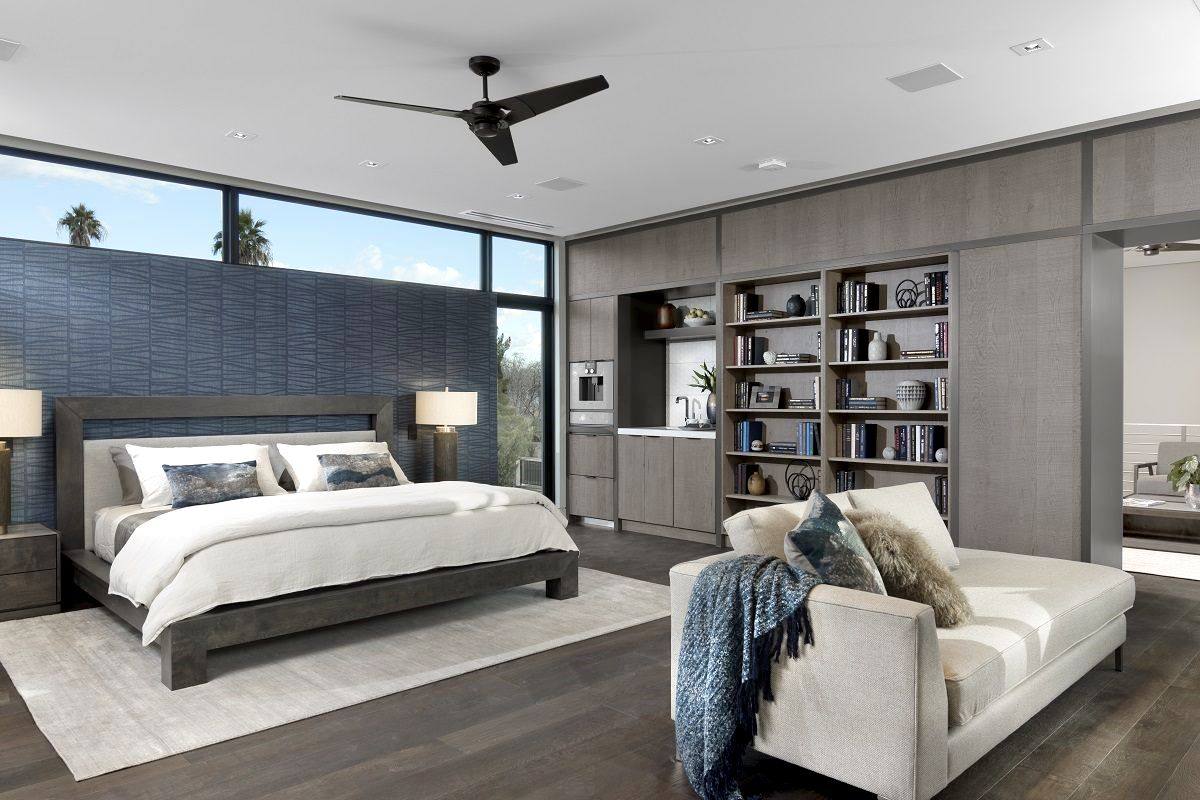
Perth has a climate that makes ceiling fans useful for much of the year. Summers are hot enough to need air conditioning on the worst days, but spring, autumn, and many summer evenings are that in-between temperature where you do not really need the ducted system or split system running. You just need some air moving.
That is exactly where a good ceiling fan earns its keep. And if you are still running an old AC fan, you are paying significantly more than you need to for that air movement.
What Is the Difference Between AC and DC Fans?
The AC and DC refer to the type of motor inside the fan, not something you adjust or control.
AC fans (Alternating Current) have been the standard in Australian homes for decades. They run directly off the 240V power supply, are simple and reliable, and use a capacitor to switch between speed settings. The typical AC fan has three speeds: slow, medium and fast. That is usually it.
DC fans (Direct Current) use a built-in transformer to convert the household AC supply into DC power before it reaches the motor. The DC brushless motor is simply more efficient. It uses only the power it needs at each speed setting rather than drawing near-constant power regardless of speed. The result is a fan that does more with considerably less electricity.
The Energy Difference Is Real and Significant
A standard AC ceiling fan running on high typically draws 60 to 100 watts. A DC ceiling fan producing similar airflow draws about 25 to 35 watts. Makers and retailers commonly quote up to 70% less power than an AC fan, and the watts on the fan's label will tell you the real figure for the model you buy.
Put that in Perth context. A ceiling fan in a bedroom or living area running for 8 hours a day through the warmer months (say October to April, about 200 days) adds up quickly:
- AC fan at 75W average: 75W × 8hrs × 200 days = 120 kWh per year
- DC fan at 25W average: 25W × 8hrs × 200 days = 40 kWh per year
At Perth electricity rates of around 30 cents per kWh, that difference is about $24 per fan per year. In a house with four ceiling fans, that is close to $100 a year, just from the fan motors. Not a fortune, but the fans also last 15 to 20 years, so the lifetime saving is meaningful.
More to the point, a DC fan on low in a bedroom overnight draws as little as 5 to 15 watts depending on the model, less than most portable appliances. You can run it all night without any meaningful impact on your power bill.
The Real Value: Replacing the Air Conditioner for Half the Year
The bigger saving is not in the fan itself. It is in what the fan replaces.
Perth summers have a significant number of days where the temperature sits between 25 and 32 degrees: warm enough to be uncomfortable without airflow, but not hot enough to justify running a split system that draws 1,000 to 2,500 watts. A ceiling fan at 25 watts moving air through a room creates enough wind chill effect to make a 28-degree room feel comfortable without cooling the air at all.
For Perth homes with good ceiling fans in the main living areas and bedrooms, the air conditioner only really needs to run on the hottest days, the 35-plus days when a fan alone is not enough. Everything else, the fans handle.
Going from running a split system 120 days a year to 40 days a year is a much larger saving than the difference between AC and DC fan motors. The fan enables the saving by being comfortable to use.
Quiet Operation: More Important Than It Sounds
AC fans hum. At low speed they can produce a low-frequency drone that becomes noticeable in a quiet room, particularly at night. The capacitor and motor combination in AC fans creates vibration that translates into noise.
DC brushless motors are inherently quieter. The motor produces less vibration, there is no capacitor hum, and at low speed, where a bedroom fan spends most of its time, a quality DC fan is effectively silent. You feel the air movement but you do not hear the motor.
For anyone who has given up on a ceiling fan in the bedroom because the noise kept them awake, a DC fan is worth trying. It is a different experience.
Speed Settings: Why More Choices Actually Matter
A standard AC fan has three speeds. That sounds adequate until you live with it.
In practice, three speeds means slow is often not slow enough for sleeping, medium is slightly too much, and fast is for when you want papers flying off the desk. Finding a comfortable setting for different people, different times of day, and different temperatures is hard with only three options.
DC fans typically offer six speed settings, and some models offer more. The difference between speed 1 and speed 2 on a DC fan is subtle, just a gentle increase in airflow. This means you can actually find the right setting for the conditions rather than toggling between too little and too much.
With a remote control, which most DC fans come with, this makes a DC fan considerably more pleasant to live with day to day.
Winter Reverse Mode
Ceiling fans have a reverse function that pushes air upward rather than downward. In winter, warm air from heating rises to the ceiling. Running the fan in reverse at low speed pushes that warm air back down toward the floor without a cold draught, recirculating the heated air you have already paid for.
AC fans technically have this too, but it usually requires physically reaching up and flipping a switch on the motor housing. DC fans include reverse as a button on the remote. In practice that makes it far more likely to get used.
For Perth homes with ducted gas heating or reverse-cycle split systems, running the ceiling fan in reverse on low during winter reduces how hard the heating system needs to work. The efficiency gain is modest but real.
Installation: What Is Involved
Ceiling fan installation in Australia must be carried out by a licensed electrician. This applies to both new installations and replacements. Even if you are swapping an existing fan for a new one, the electrical connection must be made by a licensed tradesperson. It is one of the many electrical services we provide across Perth metro.
A straightforward ceiling fan swap, on existing wiring at a standard ceiling height, takes around 30 to 45 minutes. A new installation where no fan point exists involves running a cable from the nearest circuit, which takes longer depending on ceiling access and distance.
One thing worth knowing for Perth homes specifically: older houses sometimes have ceiling fan wiring that was not run with a separate speed controller circuit. If you are adding a wall-mounted speed controller or smart switch control to an existing fan point, this is worth checking before buying the fan, because some installations need a minor wiring change to support controller options.
What to Look for When Choosing a DC Fan
Not all DC fans are equal. A few things worth checking:
- Blade span: larger rooms need larger fans. A 52-inch fan suits most standard Perth bedrooms and living areas. Going too small means the fan has to run at higher speeds to move the same air volume, which reduces the quiet-operation benefit
- Motor warranty: quality DC fans carry a 10 to 15 year motor warranty. A 2-year warranty on a DC fan is a red flag about motor quality
- Remote included: most DC fans include a remote as standard. If it does not, factor in the cost of adding one
- MEPS rating: look for fans that meet Australian Minimum Energy Performance Standards. This is the baseline regulatory requirement and filters out the worst performers
- Reversible: confirm the reverse function is remote-controlled, not a manual switch on the motor housing
As with most electrical products, the cheapest option tends to have a noisier motor, shorter warranty, and less precise speed control. A mid-range DC fan from a reputable Australian supplier will outlast several budget options and deliver the quiet operation that makes the upgrade worthwhile.
If you are replacing existing fans or installing new fan points in a renovation, we are happy to advise on sizing, placement, and compatible speed controller options for your home. See our full electrical services for everything else we can help with.
Need Help With This?
Dextel Electrical & Security Services serves Perth metro. Free quotes, no obligation.
Get a Free Quote →