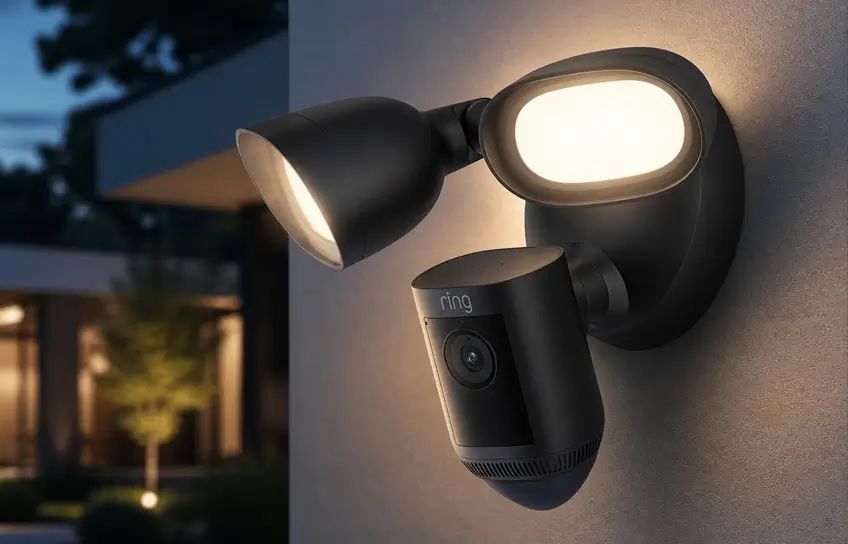
We call them security lights, but that name oversells the security part and undersells the everyday usefulness. A motion sensor light does two simple things: it turns on when something moves nearby, and it turns off again after a set time. That is the entire mechanism.
What those two things achieve depends on who is approaching your house, and why.
The Honest Version of the Deterrent Argument
Burglars prefer darkness. That is basic logic about opportunistic crime. A dark side passage, an unlit driveway, a shadowy back gate: these give an intruder the cover they need to approach a property, attempt entry, and potentially leave again without being seen. Remove that cover and the risk calculation for an opportunistic burglar changes significantly.
The key word is opportunistic. A motion sensor light that suddenly illuminates a person approaching your property does several useful things simultaneously. It removes their cover of darkness. It may attract the attention of a neighbour or someone inside the house. And it signals that the property has active security, which on its own puts off anyone assessing whether a target is worth the risk.
The caveat: a determined and experienced burglar will not be stopped by a sensor light alone. Research on the effectiveness of motion lighting shows mixed results when used in isolation. Motion sensor lights are very effective in surprising and deterring criminals, but they work best as part of a layered approach rather than a standalone measure. Combined with a visible alarm system, CCTV, and good physical security on doors and windows, sensor lights add a meaningful layer to an overall picture that says this property is not an easy target.
One more thing about lights left on permanently. Leaving a light on all night can work against you. It can look like nobody is home, and a light that comes on at the exact same time every night is easy to notice for someone casing a property. A motion sensor light that triggers unpredictably is considerably more useful as a deterrent than a light that burns all night.
The Practical Use Case Most People Appreciate More
Beyond the security angle, the most common feedback we hear from clients after installing sensor lights is simply: they are convenient.
Walking from the car to the front door at 10pm. Checking the letterbox after dark. Taking the bins out. Going to the shed. Letting the dog out at midnight. These are the moments a sensor light earns its keep every day. It has nothing to do with intruders and everything to do with seeing where you are putting your feet.
An entry path lit automatically when you approach it is more useful than a light you have to switch on, and considerably more useful than a light that nobody ever bothers to turn on because the switch is inside. Coming on by itself is the whole point, not an inconvenience.
Retrofit Sensor vs New Fitting: Two Ways to Get There
There are two approaches to adding motion sensor lighting to an existing home:
Replace the fitting entirely. A combined sensor light fitting (a floodlight or wall light with a built-in PIR, or passive infrared, sensor) is the most common approach for new installations. The fitting contains the light source and the sensor in one unit. These are available in a wide range of styles from basic weatherproof floodlights to more architectural wall-mounted designs that suit a contemporary Perth home without looking like a construction site.
Add a sensor to an existing fitting. If you have an existing exterior light that you like but want motion-activated, a separate PIR sensor module can be wired into the circuit to control it. This gives the light the same automatic behaviour without replacing the fitting itself. It is particularly useful for feature lighting or architectural fittings where the appearance matters and a combined sensor-floodlight would look out of place.
Both approaches require a licensed electrician to wire the connection. Exterior lighting is mains-powered and must be installed to Australian Standards. It is not a weekend DIY job, whatever the packaging suggests.
PIR Sensors: How They Actually Work
Almost all sensor lights use a PIR (passive infrared) sensor. PIR sensors detect changes in infrared radiation within their field of view. A warm body moving through the detection zone creates a change in the infrared pattern that triggers the sensor and activates the light.
A few practical points about how this works in reality:
PIR sensors detect movement across the detection zone, not movement toward them. A person walking parallel to the sensor face triggers it reliably. A person walking directly toward the sensor head-on is less reliably detected because the thermal change is more gradual. That affects placement: the sensor should sit so people walk across the detection zone rather than straight at it.
Heat sources trigger PIR sensors. Cats, dogs, possums, and birds all trigger outdoor PIR sensors. That is normal and expected. In Perth, warm nights mean the ambient temperature is closer to body temperature, which can slightly reduce detection reliability in peak summer. Quality sensors handle this better than budget units.
Detection range and angle vary significantly between products. A standard PIR sensor covers approximately 10-12 metres at 120 degrees in front of the unit. Better quality sensors offer adjustable range and sensitivity settings. Where a particular area matters, like a long driveway or a side passage, choose a sensor that suits the shape of the space rather than whatever is on the shelf.
Where to Place Sensor Lights for a Perth Home
Positioning matters more than most people expect. A sensor light pointed in the wrong direction, too high, or covering the wrong zone provides less benefit than its location suggests. Lighting designed in a pattern that does not allow an intruder to simply move around the lights is the goal, with no dark areas or blind spots where someone could hide.
For a typical Perth suburban home, the most useful locations in priority order:
- Front entry and driveway: the primary approach to the property. Coverage from the street edge to the front door, triggered by anyone approaching on foot or by vehicle. This is the highest-value location for both deterrence and everyday convenience
- Side passages: the path from front to back yard on each side of the house. These are the most common approach routes for anyone who does not want to be seen from the street. A sensor covering the length of each passage removes the concealment they provide
- Rear yard and back door: coverage of the back entry and any external access points. Particularly important if the back of the property is accessible from a laneway or neighbouring property
- Garage entry: if the garage connects to the house interior, the area immediately outside the garage door is worth covering. Garage entries are a common target because they are often less visible from the street
- Garden paths and steps: lower priority for security but high value for the convenience use case. Steps lit automatically at night prevent trips and falls and make the property more usable after dark
Sensor Light Options: What Is Available
The range of sensor light products available in Australia has improved considerably. The days of choosing between an ugly halogen floodlight and a slightly less ugly halogen floodlight are over. Current options include:
LED floodlights with integrated PIR: the workhorses. Weatherproof, high lumen output, long LED life, adjustable sensor settings. These suit utility areas, driveways, and any location where performance matters more than aesthetics. Most have adjustable sensitivity, detection range, and on-time duration.
Architectural wall lights with sensor: more considered designs that suit contemporary Perth homes without looking industrial. Available in a range of finishes including black, white, and brushed aluminium. These suit front entries, entertaining areas, and anywhere the light is visible from inside.
Dual-function sensor lights: some fittings offer a sensor mode for after dark and a continuous-on mode that can be manually activated. Useful for entertaining areas where you want permanent light during a gathering but automatic operation the rest of the time.
Smart sensor lights: lights that connect to your home network and can be controlled via app, integrated with a smart home system, or linked to your alarm or CCTV. When a sensor light triggers, the event can send a notification to your phone, which is handy when you are away. These are worth considering if you already have a smart home setup or an Ajax security system.
A Note on Sensor Sensitivity Settings
Most quality sensor lights have three adjustable settings: sensitivity (how easily the sensor triggers), detection range (how far away movement is detected), and on-time (how long the light stays on after triggering).
Getting these settings right for the specific location makes a big difference to how useful, and how annoying, the light is. A sensor covering a busy footpath set to maximum sensitivity will trigger every 30 seconds all evening. A sensor covering a long driveway set to minimum range will miss approaching vehicles entirely.
When we install sensor lights, we set these appropriately for the location before finishing the job. For anyone adjusting an existing sensor, the settings are usually accessible through a small panel on the sensor housing. The product manual shows how.
Combined Camera and Sensor Light Units: Ring, Reolink and Similar
Combined floodlight and camera units from brands like Ring, Reolink and Eufy sit right between sensor lighting and CCTV, and they have become popular for good reason.
The idea is simple: a motion-triggered floodlight with a built-in camera that records when the light activates. One fitting handles illumination, detection, and recording simultaneously. When something triggers the sensor, the light floods the area, the camera captures footage, and you get a notification on your phone with a live or recorded clip.
For a front driveway or rear yard where you want both light and camera coverage, this is a practical and reasonably priced solution. The light solves the night vision problem that standard CCTV struggles with. Instead of relying on infrared, the floodlight gives the camera real light, so it records in colour. The footage quality in those conditions is typically very good.
Where they work well:
- Single points like a driveway, a back door or a gate, where one unit does everything needed
- Rental properties or situations where a full wired CCTV system is not practical
- Adding coverage to a gap in an existing system
- Homeowners who want phone notifications and remote viewing without a full NVR setup
Where they have limitations:
- Ring floodlight cameras rely on Wi-Fi and a cloud subscription. If the internet goes down or the subscription lapses, recording stops. They are also dependent on the manufacturer maintaining their cloud platform and app
- Coverage is fixed to one direction per unit. A driveway might need two units to cover both the entry and the approach from each side
- They are not a replacement for a dedicated NVR-based CCTV system where continuous recording, multiple camera management, and long-term local storage are required
- Hardwired versions still need a licensed electrician. The battery-powered Wi-Fi models can be DIY installed, but battery management becomes an ongoing task
Reolink in particular has improved significantly in recent years and their hardwired floodlight camera units represent good value for a professionally installed single-point solution. Ring is the most widely known brand but their ongoing subscription model for cloud storage is worth factoring into the total cost. For broader coverage with continuous local recording, our CCTV installation page covers the dedicated NVR-based option in more detail.
If you are considering a combined unit for one or two specific locations, or want to discuss whether it suits your situation better than a conventional sensor light or dedicated CCTV camera, we are happy to advise.
If you are thinking about sensor lights, whether new fittings, a sensor on an existing light, or part of a bigger security setup, we are happy to take a look and advise on where they go and what to buy. See our full electrical services and security systems for everything else we cover.
Where a sensor light is not enough on its own, the deterrent cameras we install pair a warm light with a siren and two-way audio. They are listed on our cameras and recorders page, and included in our CCTV packages.
Sensor lights were named as a deterrent by 22.8% of burglars in a WA study. The Perth burglary statistics and home security guide has the full figures and what else puts burglars off.
Need Help With This?
Dextel Electrical & Security Services serves Perth metro. Free quotes, no obligation.
Get a Free Quote →