Figures current to WA Police data extracted 6 July 2026 (2025-26 financial year) and ABS Recorded Crime - Victims 2025 (released 3 September 2026).
The short answer
- Burglary in WA is falling: 13,312 victims in 2025, down 20% and the lowest in the ABS's 33-year series. [A]
- It is still common. Perth metro recorded 5,312 dwelling burglaries in 2025-26, more than 14 homes a day. [B]
- The Fremantle District, which covers Cockburn, recorded 774, at a rate of 239.4 per 100,000 people against a metro average of 216.5. [B]
- Most burglaries are not planned. In a WA study of active burglars, 57.8% called theirs spontaneous and 66.2% walked in through an unlocked door or window. [E]
- What put them off: a dog, a working alarm, sensor lights. Fake alarms and fake cameras did not. [E]
Most people start looking at alarms and cameras for one of three reasons: a neighbour got broken into, their car was tampered with in the driveway, or they are about to go away and do not like the idea of an empty house. This page covers what the official numbers say about burglary in Perth and around Cockburn, what burglars themselves say puts them off, and what each part of a security system does, so you can decide what you need before anyone tries to sell you anything.
Two sources are used, and they measure different things. The ABS counts victims across calendar year 2025 for the whole state. WA Police count offences recorded in the 2025-26 financial year, broken down by police district. The two will not match and I have not mixed them.
Is burglary getting worse in Perth?
No. Police-recorded burglary in Western Australia dropped 20% in 2025 to 13,312 victims, the fourth decrease in a row and the lowest number in the ABS's 33-year series. [A]
That is worth saying up front, because a lot of security marketing pretends otherwise. Falling does not mean gone, though:
- Two thirds of WA burglaries (67%) happened at a residential location, and 74% involved property being taken. [A]
- Across the Perth Metropolitan Region, WA Police recorded 5,312 dwelling burglaries in the 2025-26 financial year, more than 14 homes every day, plus 2,504 non-dwelling burglaries (sheds, garages, businesses). [B]
- Over the same period, metro police also recorded 6,117 thefts from dwellings (items taken from a home or yard without a break-in), 3,119 stolen vehicles and 14,434 thefts from vehicles. [B]
Which parts of Perth have the most burglaries?
WA Police publish figures by police district. Comparing raw counts is unfair because districts have different populations, so the rate per 100,000 people is the better guide. The table is sorted by that rate, highest first. The Metropolitan Region figures include the Mandurah District, and the eight districts below add up to the metro total. [B]
| District | Dwelling burglaries | Rate per 100,000 people | Sanction rate |
|---|---|---|---|
| Mandurah | 1,071 | 309.9 | 30.9% |
| Cannington | 684 | 271.8 | 49.7% |
| Armadale | 750 | 257.0 | 36.1% |
| Fremantle | 774 | 239.4 | 28.6% |
| Perth | 355 | 206.5 | 45.9% |
| Midland | 627 | 200.3 | 43.4% |
| Mirrabooka | 559 | 167.7 | 46.5% |
| Joondalup | 492 | 116.4 | 44.7% |
| Metropolitan Region | 5,312 | 216.5 | 39.1% |
The spread is wide. Joondalup's rate was well under half of Mandurah's. The Fremantle District, which covers Cockburn, was fourth of the eight and somewhat above the metro average. These are district figures, so they say little about any one street.
What is a sanction rate? WA Police publish the share of offences resolved with an outcome such as an offender being processed. The Fremantle District's 28.6% for dwelling burglary was the lowest of the eight districts, against 39.1% metro-wide. (Definition: see the Quality Statement and Glossary on the WA Police crime statistics page. [C]) In plain terms, the most reliable way to avoid a burglary is to not be the house that gets picked.
Burglary in Cockburn, Spearwood and the southern suburbs
Spearwood, Coogee, Success and Yangebup are covered by Cockburn Police Station. [D] Hamilton Hill, Bibra Lake and South Lake are covered by Murdoch Police Station. [H] Both stations are in WA Police's Fremantle District.
WA Police figures for the Fremantle District, 2025-26 financial year: [B]
| Offence | Fremantle District | Rate per 100,000 people | Metro average rate |
|---|---|---|---|
| Burglary (dwelling) | 774 | 239.4 | 216.5 |
| Burglary (non-dwelling) | 346 | 107.0 | 102.1 |
| Stealing from dwelling | 861 | 266.3 | 249.3 |
| Stealing of motor vehicle | 471 | 145.7 | 127.1 |
| Stealing from motor vehicle | 2,183 | 675.2 | 588.3 |
The district sits somewhat above the metro average on a per-person basis for each of these offences. That is roughly two home burglaries a day across the district.
In Spearwood itself, WA Police recorded 50 burglaries of all types (dwelling and non-dwelling combined) in 2025-26. The suburb dashboard does not split them, so this figure is not comparable with the district table above. [C]
Further south, the Mandurah District, which includes Rockingham [I], recorded 1,071 dwelling burglaries, a rate of 309.9 per 100,000 people, the highest of any metro district in the table above. [B]
When do burglaries happen?
The WA study of burglars found both night and day are used: 43.1% preferred 6 pm to 7 am and 37.9% preferred daytime. [E] An empty street on a weekday morning is not a safe one.
Month to month, the police figures do not show a big holiday spike. In the Fremantle District, dwelling burglaries ran from 51 (May 2026) to 78 (August 2025) a month, and December 2025 was 61. Across the whole metro region the range was 357 (May 2026) to 489 (September 2025), with December at 447. [B] Counts at district level are small enough that I would not read much into any single month. The takeaway is that the risk does not switch off outside the school holidays.
That matters more if your house is empty or half empty on a roster rather than for one trip in January. What a household on a fly in fly out schedule should do differently is set out in the best alarm system for FIFO workers.
How burglars get in, and what puts them off
The Australian Institute of Criminology interviewed people detained by WA Police who admitted committing burglaries in the previous 12 months, including ones they had never been caught for. It is an older study (2012 interviews, 69 participants), but it is WA-specific and it asked active offenders directly. [E]
- Most break-ins are not planned. 57.8% described their burglaries as spontaneous. [E]
- Two thirds walked straight in. 66.2% typically entered through an unlocked door or window. [E]
- It is fast. Three quarters took less than five minutes to get in, and the most common time spent inside was 5 to 15 minutes. [E]
What put them off (share of burglars who named each): [E]
- Fake gear backfires. Participants said fake alarms and fake cameras did not deter them. They read them as a sign of a house with minimal real security. [E]
- An alarm only counts if it is on. The study notes, citing WA Police, that alarms are effective only when they are actually armed. [E]
- "Lights and radio on" is a known trick. Burglars called it one of the "oldest tricks in the book" and said it can advertise that nobody is home. [E]
What this means in practice: the job of a security system is to make your house look like more risk and more hassle than the one down the street, and to make noise fast if someone tries anyway.
If a neighbour has just been broken into
This is the moment many people start looking, and it is often the middle of the day, which fits the study's finding that daytime is a common choice. [E] A few things worth doing straight away:
- Check your own doors and windows. Two thirds of the burglars in the study walked in through something unlocked. [E] Side gates, back doors and garage doors are the usual ones people forget.
- Talk to your neighbour. Find out how the person got in and roughly when. It tells you what to look at on your own place.
- Report what you saw or filmed. Call 000 if a crime is in progress. For information afterwards, WA Police Assistance is 131 444. If you have a camera covering the street side, footage can help police with a nearby incident, and you can register your cameras so they know where to ask. The CCTV laws guide covers how.
- Do not wait for the next one. Because most burglaries are not planned, [E] the aim is to make your house the awkward one on the street, not to build a fortress.
Going away: how to leave an empty house
An empty house is the situation most people worry about, and a few ordinary habits matter more than gadgets. WA Police publish a home security checklist that covers the basics. [F]
- Arm the alarm every time you leave, including short trips. The study notes that an alarm only helps if it is switched on. [E]
- Do not rely on a light or radio left on. The burglars in the study called it one of the oldest tricks in the book and said it can advertise that nobody is home. [E] Someone looking in on the place, and an alarm that alerts your phone, are better answers.
- Have someone look in. A neighbour or friend who collects the mail and puts the bins out means the house does not look untouched for a week.
- Check in from your phone. With an app-connected alarm you can see whether it is armed and which sensor tripped. With cameras you can look at the driveway and the back door yourself.
- Keep travel plans off social media until you are home.
Protecting your car and driveway
Metro police recorded 3,119 stolen vehicles and 14,434 thefts from vehicles in 2025-26, [B] and 58% of vehicles stolen in WA in 2025 were taken from an outbuilding or residential land, in other words from driveways, carports and garages. [A]
The practical steps are simple: lock the car, take valuables out of sight, and light and watch the driveway. Sensor lights were named as a deterrent by 22.8% of the burglars in the study. [E] A camera covering the driveway also gives you footage if something does happen. The sensor lights guide covers what to look for, and the floodlight cameras guide covers cameras with built-in lights.
Free and cheap steps before you buy anything
Two thirds of burglars in the WA study walked in through an unlocked door or window. [E] Before spending anything:
- Lock every door and window when you leave, including the garage, the side gate and the door between the garage and the house.
- Do not hide spare keys outside.
- Keep valuables out of sight from windows.
- Arm the alarm every time you leave, if you have one.
- Add sensor lights at the entry points. They were named as a deterrent by 22.8% of the burglars. [E]
- Work through the WA Police home security checklist for anything missing. [F]
Alarm, cameras or both?
They do different jobs, and the table shows where each one is strong.
| Job | Alarm | Cameras |
|---|---|---|
| Alerts you when a door, window or room is breached | Yes, from the moment the sensor trips | Only where a detection zone is set up, using person or vehicle detection |
| Makes noise to interrupt a break-in | Yes, sirens inside and out | Only on active deterrence models with a siren and lights |
| Shows you what happened | Which sensor tripped and when | Live and recorded video |
| Evidence for police | An event log | Footage |
| What it covers | Every protected door, window and room | Whatever the lens can see, mostly outdoors |
| What burglars said in the WA study | A working alarm was named by 49.1% as a deterrent | Fake cameras did not deter. Real cameras were not measured |
A rule of thumb: if your main worry is someone getting in while you are out or asleep, start with the alarm. If it is the driveway, the car, parcels or having evidence, start with cameras. Many homes end up with both, and one visit and one quote covers it. The CCTV and alarm page shows how the two fit together.
What each part of an alarm does
The hub (control panel)
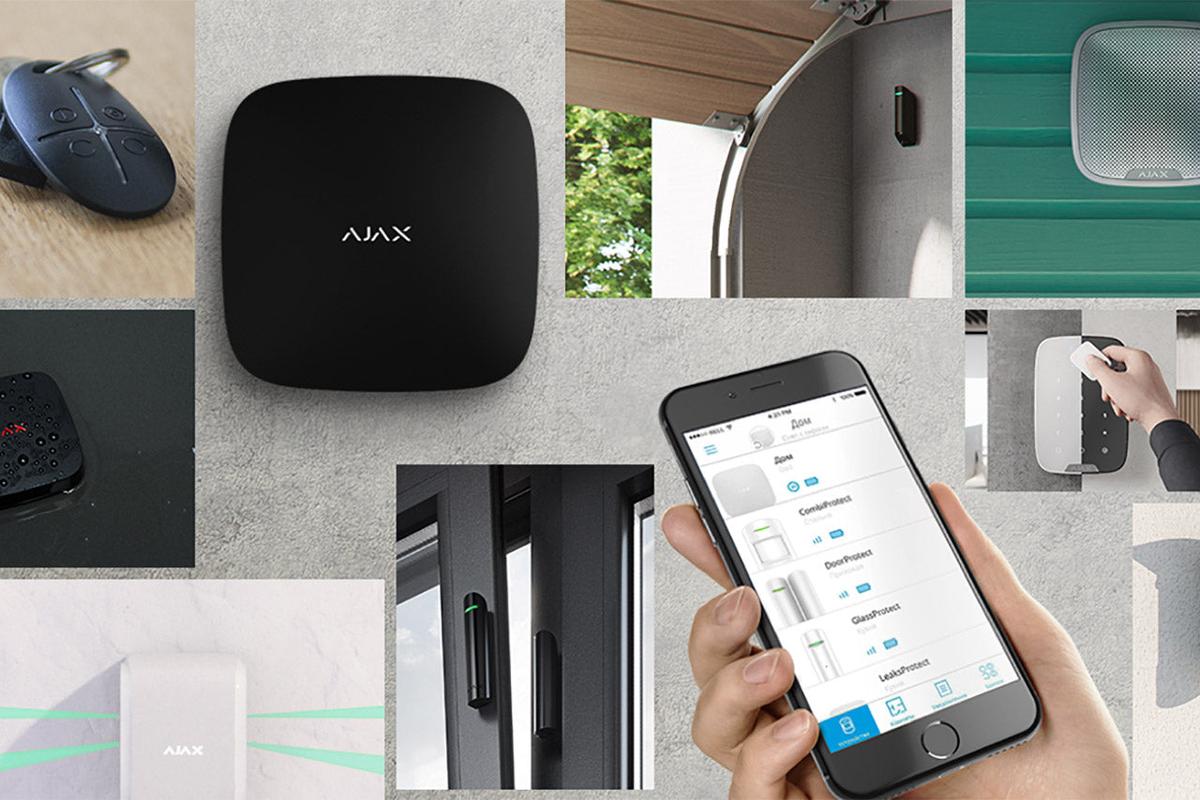
The brain of the alarm. Every sensor reports to it, it decides whether to sound the sirens, and it sends alerts to your phone. A good hub has a backup battery so it keeps working in a power cut, and a second way to report if the internet drops. The Ajax Hub 2 used in the standard packages connects over Ethernet with a SIM card as backup, and Ajax rates its battery at up to 15 hours when running on a SIM alone. A security system should not rely on a single connection. The Ajax alarm page shows how the hub connects.
Door and window contacts (reed switches)
A two-part magnetic sensor fitted to a door or window. When the door opens and the magnet moves away, the sensor trips. These protect the perimeter: they react the moment an entry point opens, before anyone is fully inside. Because they do not sense movement, they are what lets you arm the alarm at night while you are home and still walk around inside.
Indoor motion detectors (PIR)
PIR stands for passive infrared. The detector watches for a change in heat moving across its field of view, which is what a person walking through a room looks like. They are placed at choke points such as hallways and main living areas that anyone moving through the house has to cross. Pet-friendly models are available and are set to ignore smaller animals; mention the size of your pet when getting a quote.
Glass-break detectors
These listen for the specific sound pattern of breaking glass. Useful where someone could smash a window rather than open it, and they trip before the intruder climbs through.
Outdoor detectors
Mounted outside to catch someone in the yard, at the side gate or by the back door before they reach the house. Given that most break-ins take under five minutes to get in, [E] catching someone earlier buys time.
Sirens (indoor and outdoor)
The thing that actually interrupts a burglary. An external siren with a flashing light also tells the neighbours which house it is. Burglars in the WA study said their main concern was drawing attention. [E]
Keypads, key fobs and the app
How you arm and disarm. The app also shows you which sensor tripped, so you can tell the difference between the back door opening and a false alarm.
Wired or wireless?
Wireless systems have no cable runs through walls, which makes them quicker to fit in an existing home and easier to take with you if you rent. Wired systems suit new builds and large properties, and a wired system with sound wiring can be worth keeping rather than ripping out. Ajax makes both and they can be combined. The retrofit guide explains how an old wired alarm can be brought across, and the Ajax versus Wi-Fi alarms guide explains how it differs from a basic home Wi-Fi alarm.
Jamming detection
Cheap radio jammers are sometimes used to try to block wireless sensors. A properly designed wireless system detects jamming and treats it as an alarm event, alerting you, rather than quietly going deaf. Ajax uses encrypted radio with frequency hopping and notifies you if it detects jamming or loses contact with a device. No wireless system can stop a jammer from transmitting; what matters is that jamming gets noticed.
Monitoring: self-monitored or a monitoring centre
Self-monitored means alerts go to your phone and you decide what to do. With a monitoring centre, the alarm is received by a person who follows an agreed response plan, and the centre charges its own fee. I connect the alarm to the centre of your choice, and you deal with them directly. Both are valid; the right one depends on how often you are reachable and how you would want an alarm handled at 3 am. The Ajax app itself has no subscription.
What each part of a CCTV system does
Cameras
Cameras do not stop a determined burglar on their own; the WA study found fake cameras did not deter anyone. Real, visible, working cameras do three useful things: they add to the "this house is a hassle" impression, they let you check what triggered an alert from your phone, and they give police usable footage. With 58% of WA vehicle thefts happening on residential land, [A] a camera covering the driveway is often the first one people want. The CCTV installation page covers the packages, and the Dahua equipment page lists the cameras and recorders with their specifications. For a real example, see the Spearwood TiOC camera install.
The NVR (network video recorder) and hard drive
The box that records everything. It stores footage from all cameras on an internal hard drive, so recording continues even if your internet drops. Drive size decides how many days of footage you keep before it is overwritten.
Night vision: infrared and colour
Most cameras use infrared LEDs that are invisible to the eye and produce a black-and-white image at night, which is enough to tell a person from a dog or a cat. Other cameras add a warm light for colour footage, which shows clothing colour and more detail. The trade-off is that a light that stays on tells an intruder exactly where the camera is, while a light that switches on only when someone crosses a detection line is a sudden change that can work in your favour.
Smart detection (person and vehicle)
Modern cameras and recorders filter what is worth an alert and what is only the wind in a tree, which cuts the nuisance notifications so the ones you do get are worth looking at.
Active deterrence cameras
Some cameras do part of an outdoor detector's job. A camera with active deterrence watches a set zone, and when a person crosses into it, it switches on red and blue strobes and a siren, and can play a voice warning. It also sends you an alert and records the event. That gives you detection, a warning to the intruder and footage from one device, in the yard or at the side gate before anyone reaches the house. The limits are worth knowing: a camera only covers what its lens sees, and the WA study asked burglars about alarms, dogs and lights, not these cameras, so it would be wrong to claim they have been shown to deter burglars. They add to an alarm rather than replace one.
Sensor lights
Cheap and effective. Sensor lights were named as a deterrent by 22.8% of the burglars in the WA study. [E]
Privacy, rebates and cost
Privacy. In WA, the Surveillance Devices Act 1998 makes it an offence to record private conversations or private activities without consent. [G] Aim cameras at your own property, keep incidental views of the street to a minimum, and be especially careful with audio recording. The CCTV laws guide goes through the rules in more detail. (General information, not legal advice.)
Rebates. Eligible WA Seniors Card holders may be able to claim the Safety and Security Rebate, and some councils run their own CCTV or safety rebates. Most need approval before you buy, so check first. The rebates guide lists what is available.
Cost. Prices for both alarm and CCTV packages are published on the CCTV and alarm page, and the conditions that apply to them are on the terms page. If you are comparing quotes, how to read a CCTV quote explains what to look for. Every price, with what changes it, is also in one place in what an alarm or CCTV system costs in Perth.
Where to start
- Worried about a break-in while you are out or asleep: start with an alarm. Put a kit together in the Ajax configurator.
- Worried about the driveway, the car or parcels: start with cameras. The CCTV builder tailors a quote to your property.
- Renting: ask your landlord first, and look at wireless sensors.
- Going away soon: arm the alarm, arrange someone to look in, and check the free steps above.
- Not sure: ring or text me and we can talk through what your place actually needs.
Dextel is a licensed electrician and security installer (EC12377 / SA54405) based in Spearwood, and I quote and install every job myself. Call 0414 464 675 or send an enquiry.
Common questions
Is burglary getting worse in Perth?
No. Recorded burglary in WA fell 20% in 2025 to 13,312 victims, the lowest level in 33 years of ABS data. [A] It is still common: Perth metro recorded 5,312 dwelling burglaries in 2025-26, more than 14 homes a day. [B]
Which part of Perth has the most burglaries?
By WA Police district, the Mandurah District had the highest dwelling burglary rate in 2025-26 at 309.9 per 100,000 people, followed by Cannington (271.8) and Armadale (257.0). Joondalup was lowest at 116.4. The Fremantle District, which covers Cockburn, was 239.4 against a metro average of 216.5. [B] These are district figures, not suburb figures.
Is Spearwood or Cockburn a high-burglary area?
The Fremantle District, which includes the Cockburn and Murdoch police station areas, sits somewhat above the metro average per person and fourth highest of the eight metro districts for dwelling burglary in 2025-26. [B] [D] In Spearwood itself, WA Police recorded 50 burglaries of all types (dwelling and non-dwelling combined) in 2025-26. [C]
How do most burglars get in?
In WA research with active offenders, 66.2% said they usually entered through an unlocked door or window. [E]
What time of day do burglaries happen?
Both. In the same WA study 43.1% of burglars preferred 6 pm to 7 am and 37.9% preferred daytime. [E]
What deters burglars most?
The burglars in the WA study named a dog (61.4%), a working alarm system (49.1%), sensor lights (22.8%), lights on inside (19.3%) and grilled windows or doors (19%). [E]
Do fake cameras or dummy alarm boxes work?
The burglars in the WA study said no, and saw fake equipment as a sign of weak security. [E]
Do I need an alarm if I already have cameras?
They do different jobs. Cameras record and let you check what is happening; an alarm makes noise and alerts you the moment a door, window or room is breached. A working alarm was the second most-cited deterrent in the WA study, after a dog. [E]
Will my alarm still work if the power or internet goes out?
A well-specified system has a backup battery in the hub and a second way to report, such as a SIM card. Ajax rates its hub battery at up to 15 hours when running on a SIM alone, and the detectors run on their own batteries, so they keep working without mains power.
Can a wireless alarm be jammed?
No wireless system can stop someone transmitting a jamming signal. What matters is that jamming is detected. Ajax uses encrypted radio with frequency hopping, and the system notifies you if it detects jamming or loses contact with a device.
Is a wired or wireless alarm better?
Neither is better everywhere. Wireless is quicker to fit in an existing home and needs no cable runs through walls. Wired suits new builds and large properties, and a wired system can be worth keeping when the wiring is sound. Ajax makes both, and they can be combined in one system.
Do I have to pay a monitoring company?
Not necessarily. A self-monitored system sends alerts straight to your phone and you decide what to do. If you want a person to receive the alarm and follow an agreed plan, the system can be connected to a professional monitoring centre of your choice, which charges its own fee and which you deal with directly.
Can my CCTV record my neighbour or the street?
In WA, the Surveillance Devices Act 1998 makes it an offence to record private conversations or private activities without consent. [G] Aim cameras at your own property, keep incidental views of the street to a minimum, and be especially careful with audio recording. (General information, not legal advice.)
Can I install an alarm or cameras in a rental?
Usually yes, but ask your landlord in writing before anything is fixed to the property. Wireless alarm sensors need very little cabling, which makes them easier to fit in a rental and easier to take with you. The privacy rules in the CCTV question above apply to renters as well.
Will pets or wind set off false alarms?
Pet-friendly motion detectors are set to ignore smaller animals, so mention the size of your pet when getting a quote. On cameras, person and vehicle detection cuts alerts from trees, cats and passing headlights, so the alerts you get are worth looking at.
How much does an alarm or CCTV system cost?
It depends on the size of the place and what you want covered. The prices for both are published on our CCTV & alarm page, so you can see them before you ring anyone. The conditions that apply to them are written on our terms page.
Are there rebates for home security in WA?
Eligible WA Seniors Card holders may be able to claim the Safety and Security Rebate, and some councils run their own schemes. See our rebates guide.
Sources
- Australian Bureau of Statistics, Recorded Crime - Victims, 2025 (released 3 September 2026), Western Australia section. abs.gov.au
- WA Police Force, Monthly Crime Statistics - Financial Year to Date 2025-26, data extracted 6 July 2026. Official source (wa.gov.au) · Archived copy of the edition cited here (PDF). WA Police updates this file quarterly; the archived copy is the exact edition these figures come from.
- WA Police Force, Crime statistics (landing page, suburb dashboard, quality statement, glossary). The Spearwood figure is from the dashboard for the 2025-26 financial year, latest data 30 June 2026. wa.gov.au
- WA Police Force, Cockburn Police Station (Fremantle District, suburbs covered). wa.gov.au
- Gately N, Fleming J, McGinty N & Scott A, The 'oldest tricks in the book' don't work! Reports of burglary by DUMA detainees in Western Australia, Australian Institute of Criminology, Trends & Issues no. 489. aic.gov.au
- WA Police Force, Burglary prevention advice checklist (PDF). wa.gov.au
- Surveillance Devices Act 1998 (WA), WA Legislation. legislation.wa.gov.au
- WA Police Force, Murdoch Police Station (Fremantle District, suburbs covered). wa.gov.au
- WA Police Force, Rockingham Police Station (Mandurah District). wa.gov.au
Need Help With This?
Dextel Electrical & Security Services serves Perth metro. Free quotes, no obligation.
Get a Free Quote →