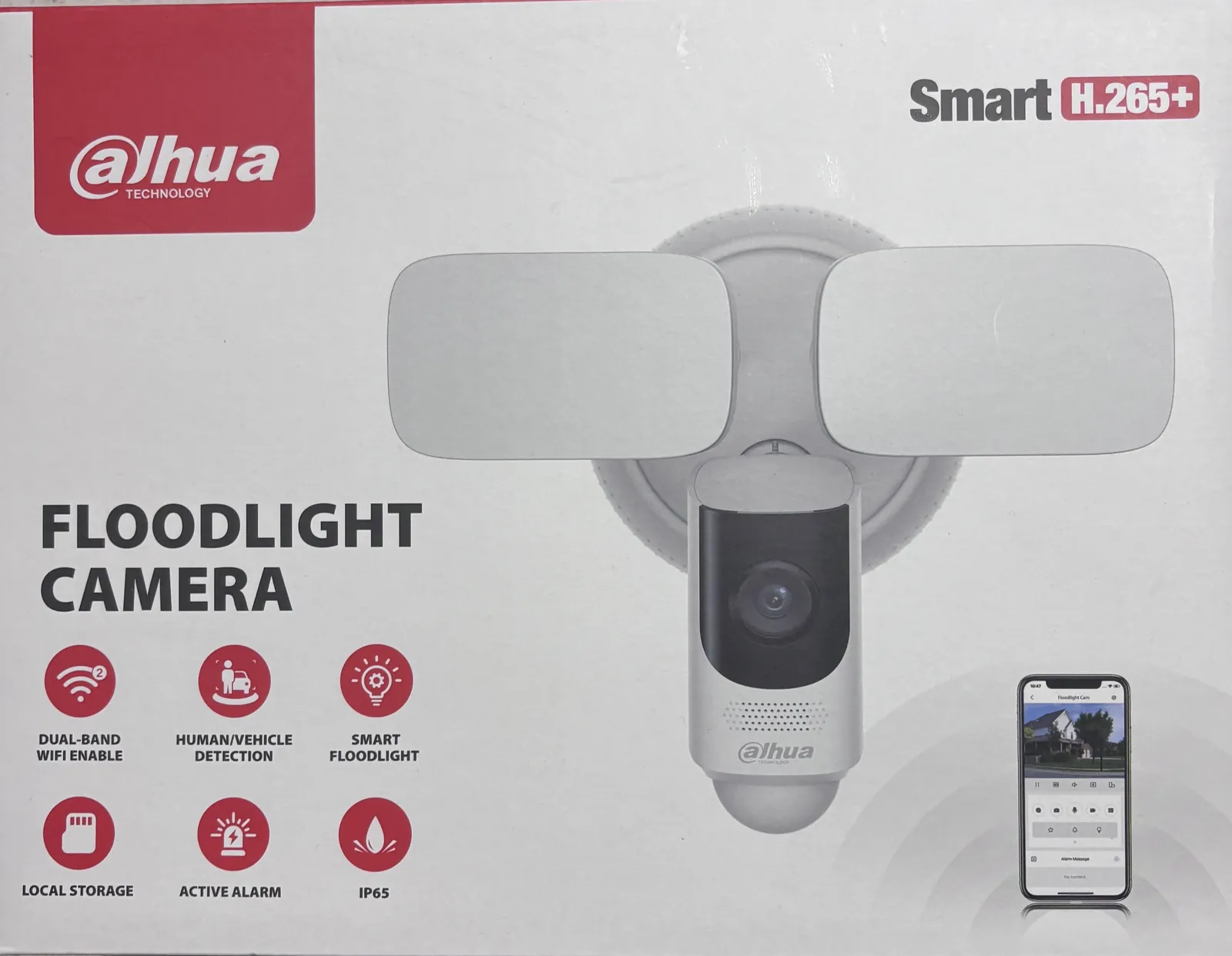
Floodlight cameras have become one of the more popular categories in home security over the past few years: a single outdoor unit that combines a motion-activated light, a camera, and usually a siren, covering one spot like a driveway or side gate without needing a separate light and a separate camera installed. Ring popularised the category for Australian homeowners, but it is worth understanding how the category actually works before assuming every floodlight camera behaves the same way, because the differences matter more than the similarities.
We fitted a Dahua IPC-WL46A at a house in Martin, which is a good opportunity to explain the category properly and why we chose this particular unit over a more familiar subscription-based option.
On the Wall
Here is that camera in place, tucked just under the roofline and still beaded with rain when the photo was taken. It is our own photo from the job, not a product shot.
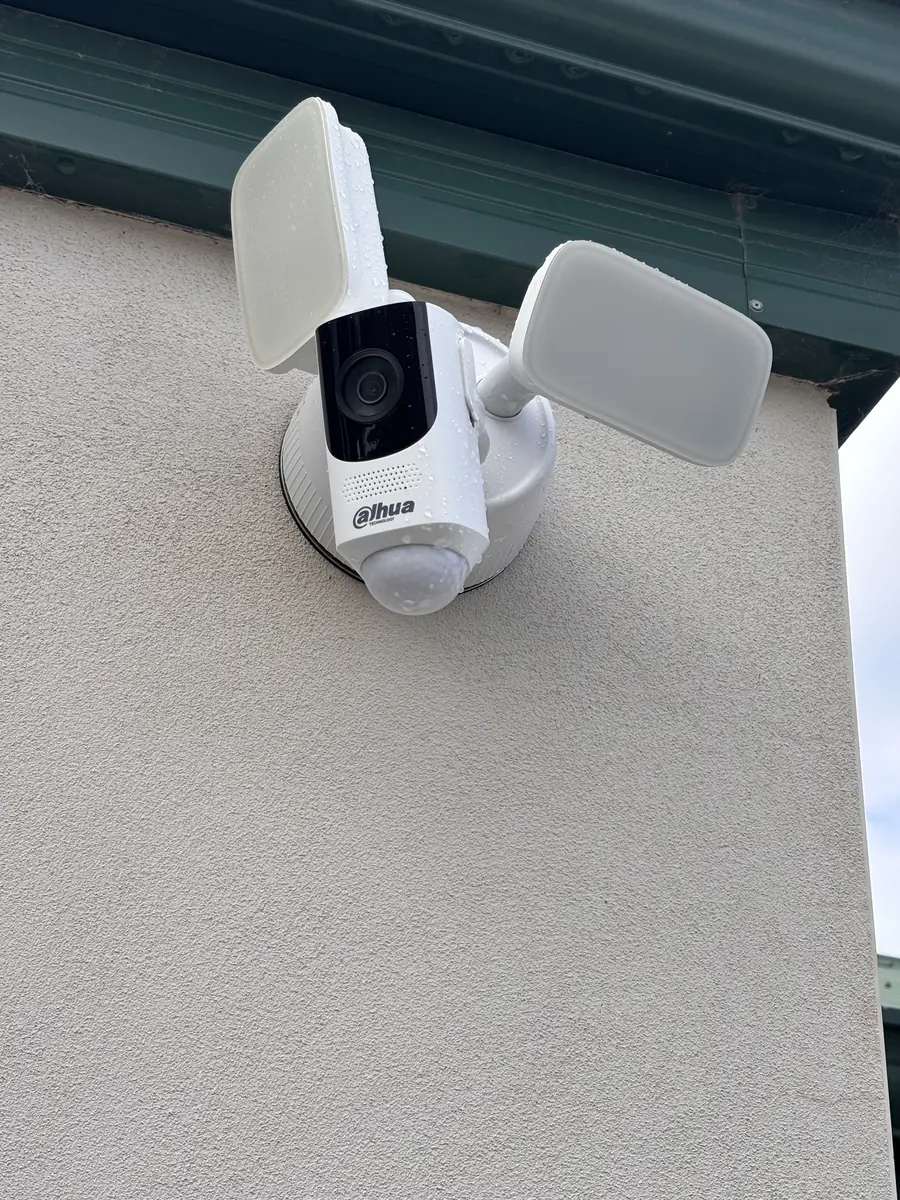
Two floodlight panels either side of the 4MP camera, with the PIR sensor underneath. Mains powered, recording locally, no subscription.
The rest of this post is the reasoning behind choosing it.
How Floodlight Cameras Actually Work
The basic mechanism is the same across every brand: a PIR (passive infrared) sensor detects movement, the floodlight activates, and the camera records the event, usually with a phone notification at the same time. Where brands really differ is in three areas: the camera sensor quality, where the footage is stored, and whether ongoing access to that footage costs anything beyond the initial purchase.
Storage and subscription is the biggest practical difference. Ring floodlight cameras require an ongoing Ring Protect subscription to access cloud video storage. Without it, the camera still detects motion and triggers the light and siren, but you cannot review recorded footage without paying monthly or annually. Other brands, including the Dahua unit we install, record locally to a microSD card, with no subscription and no recurring fee. You own the footage on hardware you control, rather than renting access to your own recordings.
Camera sensor quality varies significantly. Many consumer floodlight cameras use a relatively basic sensor optimised for a wide field of view rather than image clarity, since the category was originally built around motion alerts rather than serious surveillance footage. Units built with a proper surveillance-grade sensor, like the 4MP sensor in the unit we installed, produce noticeably clearer footage, which matters if you ever need to identify a face, a vehicle, or a number plate rather than just confirm that something moved.
What We Chose and Why: Dahua IPC-WL46A
Two things decided it, and neither of them is on the spec sheet.
Where the footage lives. Ring records to the cloud, and access to that recording depends on an ongoing subscription. Dahua records to a microSD card inside the camera, and supports RTSP and NVR storage so the stream can be pulled into a recorder or video management system. We do not accept cloud-only recording as security. Footage that exists only on someone else's server, for as long as you keep paying for it, is not footage you control. Stop the subscription, lose the connection or get locked out of the account, and the evidence is simply not there. A security device keeps its recording on site, on hardware the owner owns.
What kind of product it is. Ring has some clever features and it is a well-made consumer device. It is not a security brand. Dahua builds surveillance equipment, and that shows in the sensor, in the analytics, and in the fact that the camera is designed to be part of a system rather than a standalone gadget with its own app. Those are different design briefs, and the difference matters more the more seriously you are treating the problem.
Beyond that, this is what stands out about this unit.
- 4MP image sensor (1/3", 2560 × 1440): a proper surveillance-grade sensor, not a repackaged consumer webcam
- Dual floodlights that switch between warm (3000K) and cool (6000K) colour temperature, with four lighting modes: motion activation, manual, schedule and PIR activation
- 110dB built-in siren for active deterrence, not just passive recording
- Two-way audio through the built-in microphone and speaker, useful for challenging someone on your property remotely, or for voice alert presets
- Human, vehicle, and animal detection: proper AI-based analytics rather than basic motion detection, which is what causes most false alarms on cheaper PIR-only systems
- 270° PIR detection range with a published trigger distance around 10 metres, though real-world reports from installers suggest reliable triggering well beyond that in practice
- Dual-band WiFi (2.4GHz and 5GHz), local storage to microSD up to 256GB, and RTSP and NVR storage support so it is not locked to its own app
- 100–240VAC power supply: mains powered, not battery, which matters for anything expected to run a floodlight and record continuously
Every figure above comes from Dahua's own datasheet, so you can check it yourself: DH-IPC-WL46A datasheet (PDF, 0.4MB) →
Local Storage in Practice
For this unit specifically, footage records to a microSD card in the housing itself, up to 256GB. Dahua also lists NVR storage, and the camera supports RTSP, which is what matters if you already run a recorder. An RTSP stream can be brought into an existing NVR or video management system rather than the camera living permanently in its own phone app.
Worth being precise about that last point rather than promising too much. This is a Wi-Fi camera from Dahua's consumer range and its default management is the DMSS app, not an NVR. The open protocols mean integration is possible, but how cleanly it lands depends on the recorder you already have, and it is worth confirming against your specific model rather than assuming. If you want a floodlight camera that is unambiguously part of a wired CCTV system from the outset, that is a different conversation and probably a different camera.
Where This Fits Compared to a Separate Light and Camera
We have written before about security sensor lights and the case for combined camera-and-light units specifically. The IPC-WL46A sits at the higher end of that combined-unit category, with a better image sensor, better light output and control, and proper AI detection rather than basic PIR-only triggering.
The trade-off with any combined unit still applies: one fitting means one coverage direction. A driveway with an awkward angle, or a property needing coverage on two sides, will likely still need more than one unit, the same consideration that applies to Ring or any other floodlight camera. It is not a replacement for a full multi-camera CCTV system covering a whole property. It is a strong, self-contained solution for a single, well-defined coverage point like a driveway, side gate, or rear entry. For whole-property coverage, our CCTV packages start at four cameras.
Why They Suit a Two-Storey House in Particular
Getting a cable down to ground level on a two-storey is the awkward part, and double brick is not really why. The concrete slab between the levels is what removes the easy route. Which is how a conventional camera on a two-storey ends up as surface conduit run down the face of the house, and nobody wants that. We do not like installing it any more than owners like looking at it.
The way around it is already on the wall. Almost every two-storey house has external light fittings that went in during construction: beside the front door, at the back entry, on the corner by the side gate. They are aimed at the approaches people actually use, and they already have power. Those are camera positions nobody ever thought of as camera positions. Replacing the fitting with a floodlight camera puts a camera exactly where power already exists, with no new cable run anywhere.
Height still matters, and it is worth checking before assuming a light point will do. We mount cameras under the eaves or at around 2.8 metres and up: high enough to be out of reach, low enough to still get a usable face rather than the top of someone's head. Some existing light positions sit right for that and some sit too low, and that is a judgement made on site rather than from the street.
The switch is not an obstacle. A floodlight camera needs permanent power rather than a switched supply, and getting it is straightforward for an electrician. The switch can be bridged so the point is always live, or a permanent active picked up from a nearby power point on the same wall. It is an install detail, not a limitation.
What This Does and Does Not Cover
Worth being straight about this, because it is where most quotes are vague: no camera system covers a whole property. Not this approach, and not a conventional multi-camera install either. Four cameras on a house leave gaps too. The difference is only whether the gaps were chosen deliberately or inherited from wherever the fittings happened to be.
So the useful question is not whether coverage is complete. It is whether the cameras are watching the approaches that matter: the ways someone would actually reach the house, and the points where you would want a face rather than a shape. Existing light positions are usually good on that measure, because lights get installed where people arrive. Where they fall short is the sides and rear of a block that were never lit, and that is a real gap worth naming rather than glossing over.
Complete coverage exists, but it is a different kind of job:
- Overlapping fields of view: cameras positioned so each one is covered by another, meaning nobody can approach and disable a camera without being recorded by the next
- Roughly double the hardware for the same property, plus the cabling and recording capacity to match
- Position dictated by coverage, not by power, which is what pushes the cost up on a double-brick two-storey in the first place
That is the right answer for a property where the risk justifies it. For most homes it is not, and knowing what the ceiling looks like is what makes the middle option a decision rather than a compromise.
What Actually Matters Once It Is Installed
A few practical things worth understanding beyond the spec sheet, regardless of which floodlight camera you choose:
- Real-world WiFi performance depends heavily on mounting position and wall material between the unit and the router. Dual-band 5GHz support helps, but distance and brick or concrete walls still affect signal strength in practice
- Whether motion-triggered lighting and AI human/vehicle detection can be configured independently of each other matters, so the floodlight does not need to be tied to the same sensitivity as the recording trigger
- Published lumen figures rarely tell the full story of how a floodlight actually performs once mounted and illuminating a real driveway or yard at night
- App setup and ecosystem integration varies between brands, so check how straightforward this is before buying, particularly if you are not already familiar with the manufacturer's app
Who a Floodlight Camera Suits
If you want a single, capable unit covering one specific point (a driveway, a side gate, the approach to a back door) without committing to a monthly subscription, this category is worth considering over a full multi-camera CCTV system, particularly if budget or scope does not call for covering an entire property. It is mains-powered, so installation requires a licensed electrician to run power to the mounting point. It is not a battery-and-WiFi unit you can mount yourself with a screwdriver.
If you are weighing up a floodlight camera for your own property, whether the Dahua unit we are installing or another option, we are happy to talk through what actually matters for your specific situation before you buy anything.
The rest of the Dahua range we install, with the deterrent models that carry a siren and warning lights, is listed on our cameras and recorders page.
Wondering how cameras compare with an alarm, and what burglars in WA said about fake cameras? See the burglary statistics and home security guide.
Need Help With This?
Dextel Electrical & Security Services serves Perth metro. Free quotes, no obligation.
Get a Free Quote →