The short answer
- Dahua is what I fit as standard. Best balance of picture, features and price.
- Ajax is my second choice. A serious product, priced nearer Hikvision, and the clear pick if you have an Ajax alarm or are planning one.
- Hikvision is third: a deep, capable system for anyone who wants it and can afford it.
- HiLook is the budget option, and a sensible one.
- None of that matters as much as where the cameras go.
I get asked which brand to buy almost every week. It is the wrong first question, and I understand why people ask it, because the brand is the only thing you can compare before you have spoken to anyone.
So here is my honest view on the four I quote in Perth, and what I would actually tell you if you rang me.
The install decides more than the brand
I have been to properties with good cameras that produced nothing useful, and properties with cheap cameras that handed police a face. The difference was never the badge on the housing.
What it was:
- Height and angle. A camera up under the gutter looking down at the top of a head is a camera that records hats. Mounted lower and angled across the approach, the same camera records a face.
- What is behind the subject. Point a camera at a bright sky or a white wall in afternoon sun and everything in front of it becomes a silhouette.
- Where the recorder lives. A recorder sitting on the hall table next to the front door is the first thing taken. It belongs somewhere out of the way, and ideally somewhere a thief has to work to reach.
- Cable, not wifi. A camera on a cable has power and network in one run and does not drop out when the microwave is on.
Get those right with a budget camera and you have a working system. Get them wrong with the most expensive camera on the market and you have expensive footage of nobody.
Night is the only spec worth paying extra for
Walk past a display wall and every camera on it is showing a bright, sharp picture. None of them are showing you a car park at midnight, which is the only picture you are actually buying.
Two things decide night footage, and neither is the number on the box. The size of the sensor, which is the chip collecting the light, and the aperture of the lens, which is how much light reaches it. A bigger sensor and a wider aperture mean a usable picture in less light.
Resolution does something different. It decides how far away a face stays readable in good light. It does not help after dark at all. I have written the long version of this in is an 8MP camera better than a 4MP one, and the short version is that people buy megapixels when they should be buying light.
Dahua: what I fit as standard
Dahua is on most of the jobs I do. The picture quality is very good for a little more than HiLook, the range is wide enough that I can match a camera to a situation rather than fitting the same thing everywhere, and the DMSS app is fine to live with.
Two of their ranges do most of the work for me:
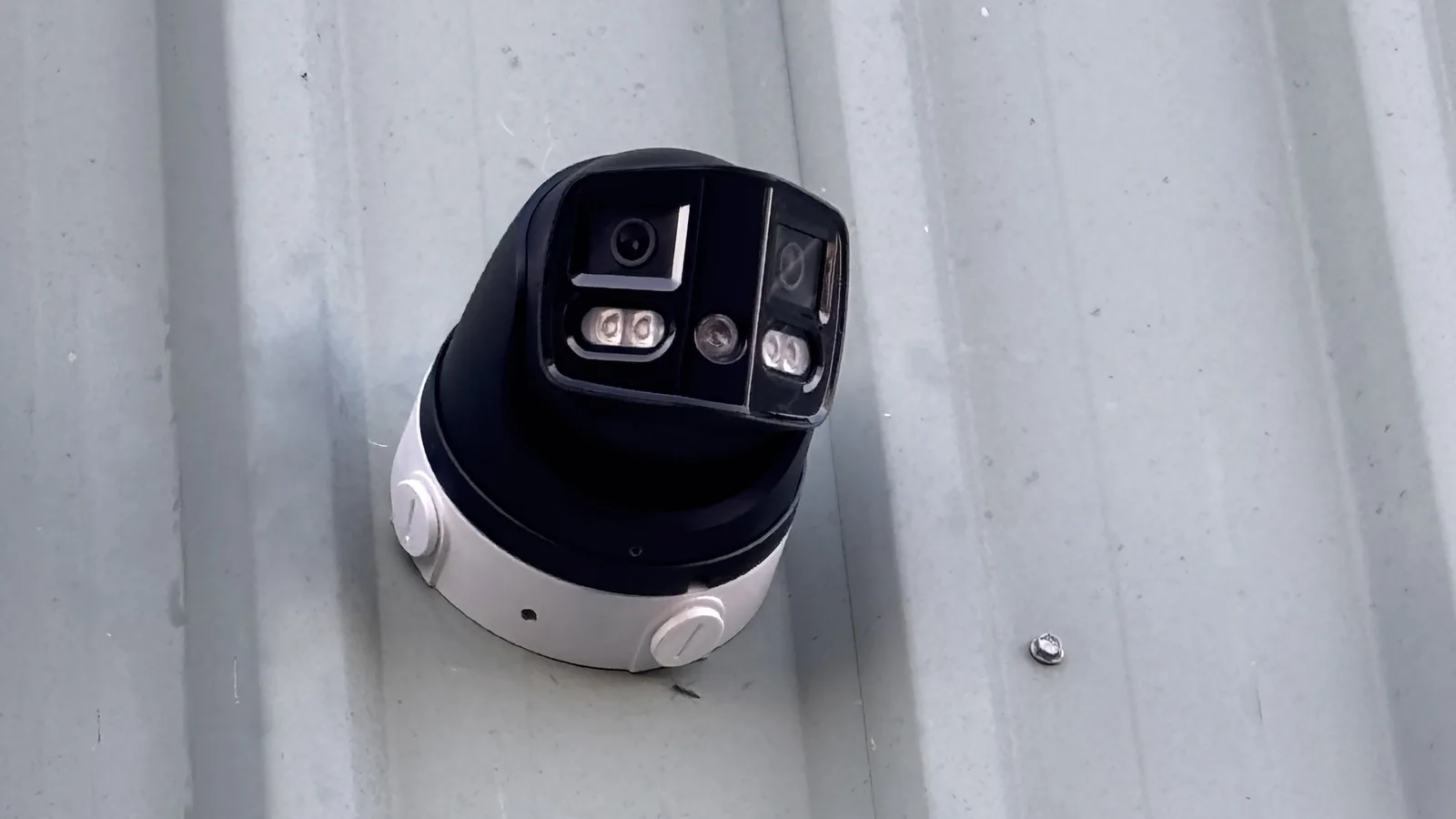
- Smart Dual Light. Runs on infrared by default, so it is not lighting up your street all night, then switches on a white light for full colour the moment it detects a person or a vehicle. You get a colour image of the thing you care about and darkness the rest of the time.
- TiOC PRO. Adds a large 1/1.8 inch sensor, a light, a siren and two-way talk. It is the camera I fit when someone wants the system to do something about an intruder rather than just record them. Being spoken to by name from a camera ends most of it.
Dahua also does its thinking in the camera rather than back at the recorder, so what reaches your phone has already been filtered. The practical difference is a handset that buzzes twice in a night instead of thirty times, and that decides whether the notifications are still switched on a month later.
Ajax cameras: my second choice after Dahua
I am an Ajax Authorised Partner and Superior certified, so take this with that in mind. Said plainly: these are a serious product in their own right, not an accessory to the alarm, and after Dahua they are what I would put on my own house.
The AI is the reason. Ajax will run it on the camera or on the recorder, your choice, and of the four brands here it is the one I trust most to get that judgement right. That is not something you can read off a box. It is what I see across jobs.
On price they sit nearer the Hikvision end than the Dahua end, so this is not the range to pick if the budget is the deciding factor. What you are paying for is the detection and the integration.
The strongest case is if you have an Ajax alarm, or you are planning one. They sit inside the Ajax app alongside your detectors. One app, one system, the alarm and the footage in the same place. When a detector trips you look at the camera covering it without changing screens.
Without an Ajax alarm you lose that, and most of the time I would put you on Dahua for the money. Not because the cameras are worse on their own, but because you would be paying for integration you are not using.
Worth knowing: an Ajax hub will also take Dahua and Hikvision cameras, and anything else that speaks RTSP, so you do not have to run Ajax cameras to see cameras in the Ajax app. And if you already have cameras, or you want the best of both worlds, the Ajax Superior NVR will happily take the cameras you already have, any brand, so long as they are IP cameras that support ONVIF, and run its own detection across the lot of them. Most IP cameras made in the last several years will work. An older analogue camera on a coax lead cannot connect. Send me the model and I will confirm. Where it fits, it is often the best value move on a property that already has decent cameras on it: keep the cameras, change the brain. More on the alarm side in is Ajax a good alarm system.
Hikvision: if you want it and the budget allows
Hikvision's professional range is a serious product with a deep feature set, and the ecosystem goes well beyond cameras into alarms, intercoms and access control. If you want it, I will quote it.
I do not fit it by default, for one plain reason: for most Perth homes it costs more than a Dahua system that does the same job. It is a better camera than its own HiLook range, and you pay for that. If you are already running Hikvision gear and want to extend it, that changes, and then it is the obvious choice.
HiLook: the budget option, and a sensible one
HiLook is Hikvision's entry-level range. Fewer features, lower price, same Hik-Connect app, and the cameras are solid. My budget packages use them.
The standard turret records in black and white at night on infrared. The strobe version adds a white light for colour. If the budget is the deciding factor, I would rather put four well placed HiLook cameras on a house than two Dahua ones, because coverage beats specification. A gap in the coverage is a gap whatever the camera costs.
Where I would not use them is a property with a long dark approach or a lot of distance to cover. That is where paying for the sensor earns its money.
What about a wireless DIY kit?
Battery cameras have their place, and that place is renting. If you cannot drill, a battery camera is better than nothing. The longer answer, including what self-installing costs you in WA rebates, is in is a DIY security system worth it.
For anyone who owns the property, I would not. The batteries need charging, the camera depends on your wifi reaching the far corner of the block, most of them want a monthly subscription to keep your footage, and the footage lives on somebody else's server. A camera that records to a drive in your house keeps working when the internet drops, and costs nothing per month.
The other thing nobody mentions in the box copy: a battery camera stuck to a wall can be taken off the wall.
The question about China
Customers ask, and it is a fair question. In 2023 the federal government ordered Hikvision and Dahua devices removed from Defence and other government buildings after an audit found almost 1,000 of them. [A] That decision was about national security sites, not houses in Spearwood.
For a home the real risks are the ordinary ones, and they are the same whoever made the camera: a default password, firmware nobody updates, and a recorder left open to the internet. What I do about each of those on every install is set out in how much an alarm or CCTV system costs, so I will not repeat it here.
If the origin still matters to you, say so and I will quote something else. Note that HiLook is made by Hikvision, so it does not answer that concern. Ajax is a European company, if that is the deciding factor for you.
So which one should you buy?
- Most homes: Dahua Smart Dual Light.
- You want the camera to intervene: Dahua TiOC PRO, for the light, siren and two-way talk.
- You have or want an Ajax alarm: Ajax cameras, so the alarm and the footage are one system. My second choice overall, at nearer Hikvision money.
- You want the deepest system and can afford it: Hikvision, or stay with Hikvision if you already run it.
- Tight budget: HiLook, and spend the saving on more cameras rather than better ones.
Then forget all of that until the property has been looked at. Camera choice is the last decision, not the first. Where the cameras go, how many, and what each one is meant to see comes first, and the brand falls out of that conversation on its own.
If you want to see prices before you talk to anyone, the published package prices are there, and the camera system builder lets you put a system together and send it to me. [B] Otherwise the CCTV installation page covers how the job runs, and businesses are on the business alarm and CCTV page.
Common questions
Which security camera brand is best?
The one that suits your property and budget, installed properly. I fit Dahua as standard, HiLook where the budget is tight, Hikvision on request, and Ajax cameras for anyone running an Ajax alarm. A well placed HiLook beats a badly placed Dahua every time.
Is HiLook the same as Hikvision?
HiLook is Hikvision's entry-level range. Same parent company, a trimmed feature set and a lower price. It uses the same Hik-Connect app. If you are avoiding Hikvision over where it is made, HiLook does not answer that.
Are Ajax cameras worth it?
Yes. They are a serious product and my second choice after Dahua, priced nearer Hikvision than Dahua. The strongest case is if you have an Ajax alarm or are planning one, because the cameras sit in the Ajax app next to your detectors and it is all one system. Without the alarm you lose that, and I would usually put you on Dahua for the money.
Do I need 4K cameras?
Not usually. Resolution decides how far away a face stays readable in good light. It does nothing for how much light the camera collects, and night is where footage either is or is not evidence. 4K is worth it on a long driveway or a front entry where you may want to zoom in.
Can I mix brands on one system?
Up to a point. Cameras from one manufacturer on that manufacturer's recorder is the clean way to do it. Most of these cameras also speak ONVIF and RTSP, so a mixed system is possible, and some features drop off when you do it. Tell me what you already have and I will tell you what works with it.
Sources
- Senator James Paterson, Marles orders removal of Chinese cameras (10 February 2023). www.senatorpaterson.com.au
- Dextel terms and conditions: clause 29.8 (package prices). Terms
Need Help With This?
Dextel Electrical & Security Services serves Perth metro. Free quotes, no obligation.
Get a Free Quote →