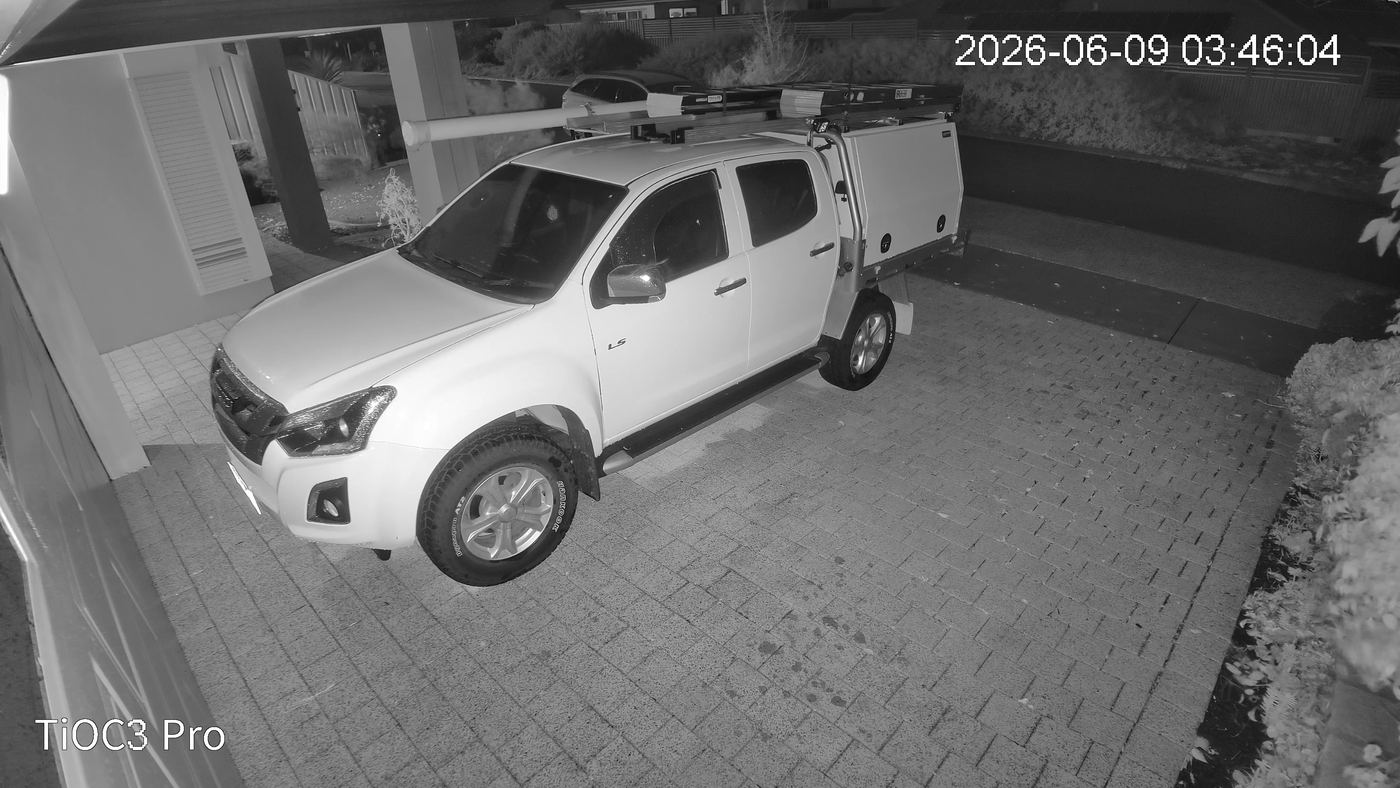
Every camera on the market looks good in the middle of the day. The one worth paying for is the one that still gives you a readable face at 11pm, because that is the hour the footage has to earn its keep.
Nothing on the box tells you which camera that is. The only number most ads give you is the megapixel count, and it is the wrong number to judge night performance by. Two cameras badged the same 6MP can be twenty-five times apart in the dark, and the pair we install that proves it is further down this page.
What decides your night footage is how much light the camera can physically collect: the size of the chip behind the lens, and how wide the lens opens to let light onto it. Megapixels decide something else entirely, which is how far away a face stays readable in good light.
"Almost every camera will give you a beautiful picture during the day. Not too many will give you one at night."
That is the first thing we say to every client when we go through camera options, because daytime footage is useless as a comparison. The question worth asking is what the camera sees at 10pm with no lights on. It is one of the things we work through when we quote a CCTV installation, and which brand that ends up being is covered in which cameras I install and why.
Is an 8MP camera better than a 4MP one?
In good light, yes, a little, and the difference shows up at distance rather than up close. After dark, often not. Megapixels tell you how finely the picture is chopped up: an 8MP camera divides the scene into about eight million dots, a 6MP camera into about six million. More dots means you can zoom further into the recording before it turns to mush.
What megapixels do not tell you is how much light reached the camera in the first place. That is a separate part of the camera, and it is the part that decides whether there is anything to zoom into at 11pm.
What actually decides whether a camera sees at night
Behind the lens of every camera is a chip that turns light into a picture. The physically bigger that chip is, the more light it collects, in the same way a wider bucket catches more rain in the same shower.
Camera makers write the size of that chip as a fraction of an inch, which is where it gets confusing, because the fractions run backwards. A 1/1.8 inch chip is physically larger than a 1/2.7 inch one. Smaller bottom number, bigger chip, more light.
The lens matters too. Its aperture is how wide it opens to let light through, written as an F number, and again lower is better: an F1.0 lens lets in more light than an F1.4 lens.
Neither of those numbers is advertised. Both are in the manufacturer datasheet, and both do more for your night footage than the megapixel count does.
Two 6MP cameras, twenty-five times apart in the dark
The clearest way to show this is with two cameras we install, both badged 6MP, so the megapixel number is identical.
Datasheets state the darkest conditions in which a camera can still hold a colour picture, measured in lux. The lower that figure, the darker it can go before it gives up on colour.
- Dahua IPC-HDW3667EM-S-IL, 6MP. A 1/2.7 inch chip and an F1.4 lens. Dahua rates it down to 0.005 lux in colour.
- Dahua IPC-HDW3649H-AS-PV-PRO, 6MP. A larger 1/1.8 inch chip and a wider F1.0 lens. Dahua rates it down to 0.0002 lux in colour.
Same megapixel count on the box. Twenty-five times the difference in how dark it can get before the colour goes. If you had compared those two cameras on their advertised number alone, you would have seen two identical products.
On the same chip, more megapixels needs more light
Now take two cameras with the same chip and the same lens, differing only in resolution. That second camera comes in a 6MP and an 8MP version, both on the 1/1.8 inch chip, both F1.0.
Dahua rates the 6MP down to 0.0002 lux in colour and the 8MP down to 0.0004 lux. The 8MP needs twice as much light to hold the same colour picture.
That is the whole answer to the opening question. Splitting the same chip into more pixels makes each pixel smaller, and a smaller pixel has less light falling on it. In good light you never notice. In a dark back yard you do.
So what do the extra megapixels buy you?
Distance. Both cameras see the same width of scene, but the 8MP has more dots spread across it, so a face stays readable further away.
There is a published standard for this, DORI, which gives the distance at which a camera can detect, observe, recognise and identify a person. On the 3.6mm lens, Dahua rates the 8MP deterrent camera as recognising a person out to 20 metres and giving a face good enough to identify out to 10 metres, against 17.1 metres and 8.6 metres for the 6MP.
So the extra megapixels earn their money where the subject is a fair way off: the far end of a block, a run of parking bays, anywhere you are asking the camera to reach. Over a front porch or a side gate, where anyone who matters is within a few metres of the camera, they buy you very little, and they cost you light.
For most Perth homes, that is why we specify the 6MP more often than the 8MP, not the other way around.
Why this shows up in a Perth back yard
Perth summer evenings are forgiving. There is streetlight, sky glow and garden lighting about, and a cheap camera can look adequate in those conditions.
The rear of a property is the problem, because it usually has no street lighting at all, and it is where someone is most likely to approach from. Add a winter night with heavy cloud and nothing on in the house, and that is the footage you end up handing to police.
If you have ever gone back through footage after an incident and found it was not good enough to be useful, how much light the camera could collect is likely a large part of why.
Colour or black and white, and why that decides whether footage is useful
Most cameras switch to infrared after dark, which gives you a black and white image. It shows you that someone was there and roughly what they did. It does not tell you the colour of their jacket, or the colour of the ute they got into.
A camera that can hold colour in low light keeps all of that. Clothing, vehicle colour, skin tone. Police and insurers can work with a colour image in ways they cannot with a grey one, and that is usually the difference between footage that is interesting and footage that is evidence.
The deterrent cameras do it two ways: they use whatever ambient light there is, and when they detect a person or a vehicle they switch on a warm white light to fill in the rest. Dahua rates both the infrared and the warm white light to 30 metres, which covers a typical driveway or rear yard.
The camera also has to know it is looking at a person
None of the above helps if the camera reacts to everything that moves. In a Perth backyard that means cats, possums, wind through a lemon tree, rain, shifting shadows, and moths drawn to the infrared light. The result is forty notifications a night and a person who stopped reading them in the first week.
Dahua calls its on-board classification WizSense. It sorts what it sees into human, vehicle or neither, and only the first two raise an event. SMD 4.0, Smart Motion Detection, is the same idea applied to the recording, so scrubbing back through a night shows you the moments that involved a person instead of every frame where something moved.
That classification is also what makes the warm light and the deterrence fire at the right moment: on the deterrent models, red and blue strobes and a siren can activate when a person is detected, so the camera interrupts an event rather than only recording it. Alongside an Ajax alarm system, that gives you two layers responding to the same approach. The deterrent camera is one of the options in our CCTV packages.
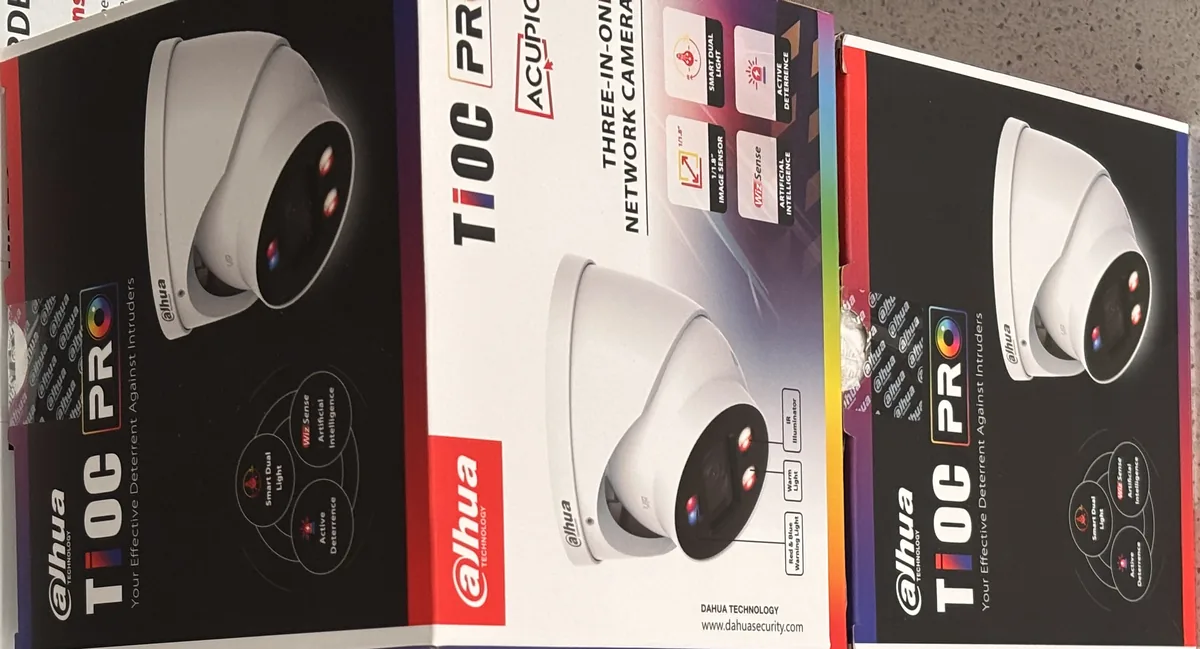
Dahua TiOC PRO cameras in stock for a Perth installation. The three circles on the box are the whole proposition: dual light, on-board AI, and active deterrence in one unit.
The feature nobody asks about until the morning after
AcuPick lets you pick a person or a vehicle out of recorded footage and search the rest of the recording for other appearances of them, instead of dragging a timeline back and forth for two hours.
If you have ever had to hand footage to police, you know why that matters. The useful part is rarely the ten seconds you already saw. It is the earlier pass along the street, the car parked two doors down, the visit the night before. This class of feature depends on the recorder as well as the camera, which is why we quote the two together rather than treating the recorder as a box to make up the numbers.
How to pick a camera without reading a datasheet
Three questions get you most of the way:
- How dark is this spot at 11pm with the house shut? A dark rear yard or a set-back driveway wants the bigger chip and the wider lens. A lit front entry does not need the premium.
- How far from the camera does someone need to be recognisable? Under about 10 metres, extra megapixels add little. Over a long approach, they earn their keep.
- Do I want colour after dark? If the answer is yes, that is a question about light collection and lighting, not about resolution.
Our approach is to put the right camera at each position rather than the same model everywhere. The better cameras go where the light is worst and where someone would actually approach, standard cameras cover the rest, and the total comes out lower than upgrading every position would.
The chip size, aperture and low-light rating of every camera we fit are listed on our equipment page. To compare quotes, see how to read a CCTV quote, floodlight cameras explained for a camera with built-in lighting, and where to put CCTV cameras on a house for positioning. For everything beyond CCTV, see our electrical services and security systems.
Planning CCTV for a low-light area?
We design CCTV around the light levels, viewing distance and coverage that matter at your property, not just a headline megapixel number. Dextel installs and configures systems across Perth metro suburbs.
Explore CCTV Installation →