No camera system covers every square metre of a property. The aim is to watch the ways someone would actually reach the house. On most Australian houses that comes down to four spots.
1. The rear alfresco door
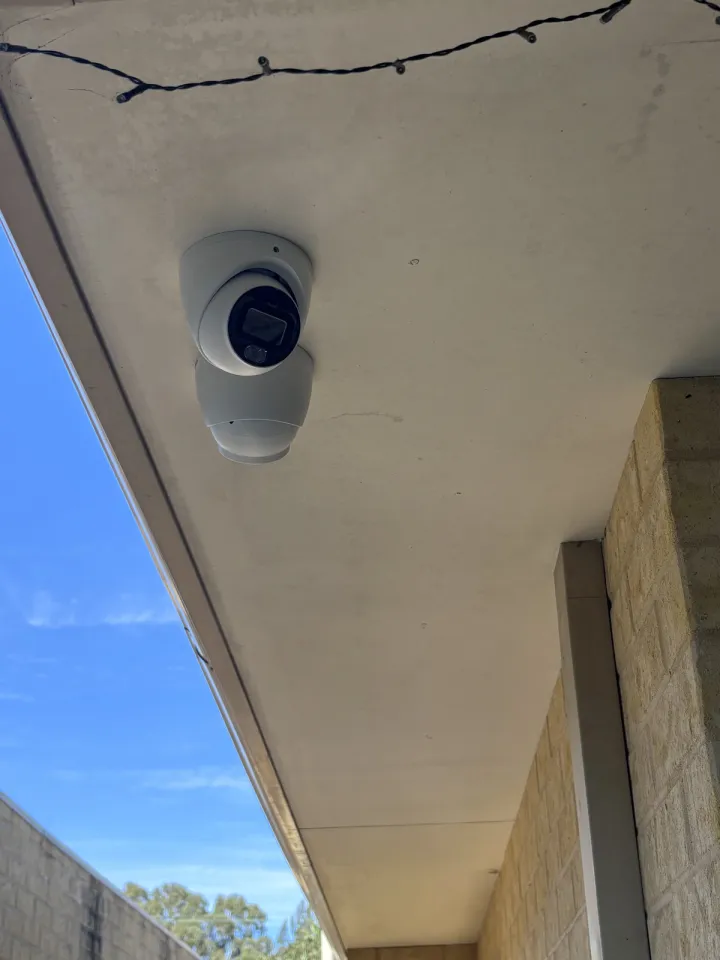
The back of a house is often out of sight from the street, and the alfresco door is the one most people use every day. A camera here covers the rear entry and the alfresco area. On the Beeliar job, two cameras share one mount under the alfresco and face opposite ways, so from one point they cover both the rear and the side of the property. Read the Beeliar write-up.
2. The side laundry door
The laundry door on the side of the house is easy to forget, because nobody thinks of it as an entrance. It is a door all the same, and it is usually out of view of the street. A camera on that side covers the door and the path along it.
3. The main entry door
The front door is where you want to see a face rather than a shape, so this camera goes where it gets a clear view of whoever is standing at the door.
4. The driveway
The driveway shows who arrives, who leaves and which vehicle they came in. It is also the approach to the garage.
How many security cameras do you need?
Start by counting the ways in, not the walls. One camera per entry point is the rule I work to, and most Perth homes are well covered by four to six cameras across the entry points, driveway and backyard. That is why the CCTV packages come in 4, 6 and 8 cameras.
- Four cameras: the four spots above, the rear alfresco door, the side laundry door, the main entry and the driveway. This suits most single-storey homes, and it runs on a 4-channel recorder.
- Six cameras: the four entry points plus the parts of the block those cameras cannot see, such as the backyard, a side gate or a second driveway. Six or eight cameras come with an 8-channel recorder.
- Eight cameras: larger blocks, or a home with a shed, workshop or second building to cover as well.
Before adding cameras, check whether better placement does the job. On the Beeliar job, two cameras on one mount cover both the rear and the side of the house. Where you may want to zoom in on a face or a number plate, the 8MP version of the same camera often does more than an extra camera would.
If you think you will want more cameras later, ask for the 8-channel recorder from the start, so adding a camera does not mean replacing the recorder. The real answer always depends on how the block is laid out. See CCTV installation for the packages, what a camera system costs in Perth, or build your system and send it to me to quote.
Placing cameras for a shop is a different job. The WA small business CCTV rebate requires at least one camera covering the customer entrance and point of sale: see the WA small business CCTV rebate guide.
Keep the cameras on your own property
Aim each camera at your own property. A neighbour's yard, pool or windows is where the legal risk sits: see CCTV laws in WA. For how the cameras cope at night, see night vision and sensor size and floodlight cameras explained.
Need Help With This?
Dextel Electrical & Security Services serves Perth metro. Free quotes, no obligation.
Get a Free Quote →