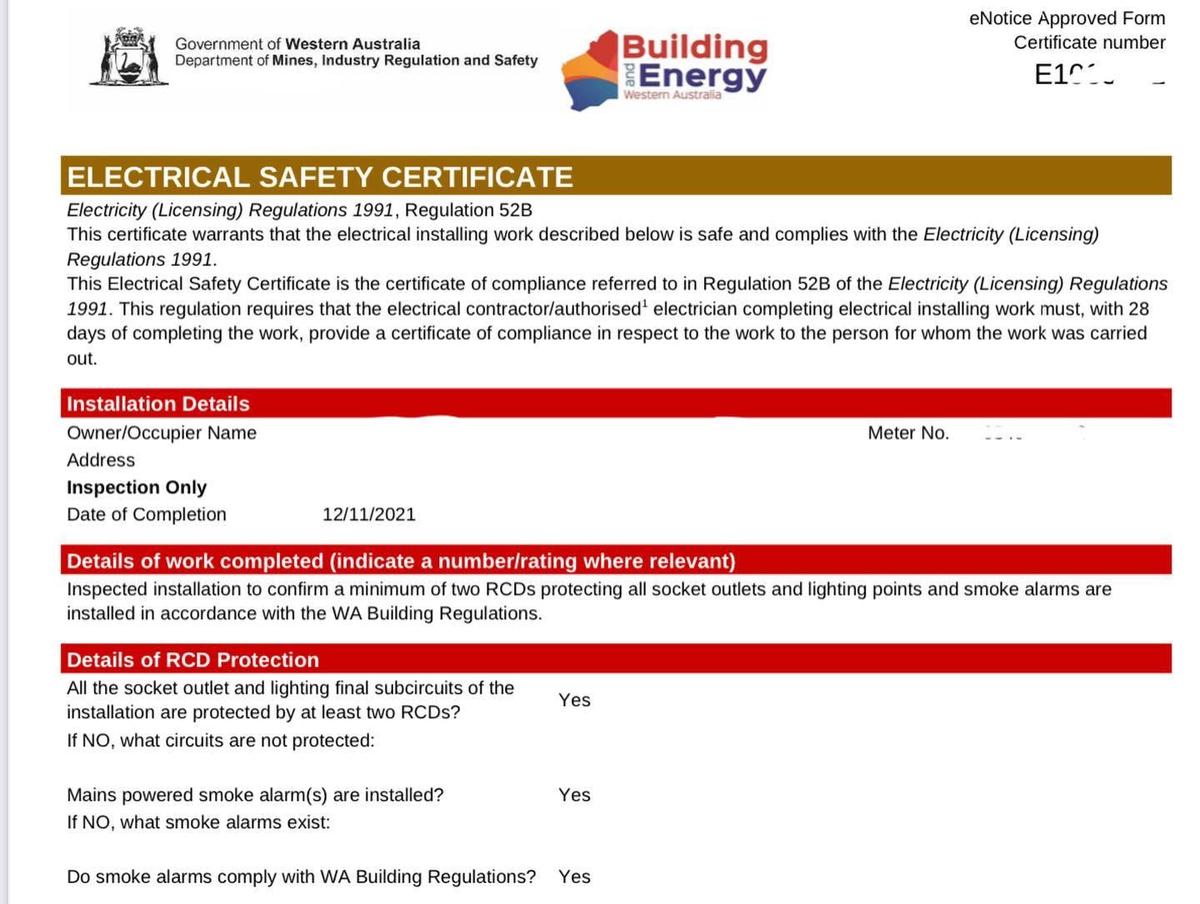
If you are selling a house in Perth, someone will eventually ask about an electrical safety certificate. The honest answer is that Western Australia does not have a single, government-mandated certificate you must produce before selling. But that does not mean there is nothing to worry about. There are two specific legal requirements that can hold up settlement if they are not met, and a strong practical case for getting an inspection regardless of what the law strictly demands.
What WA Law Actually Requires Before You Sell
Two requirements are mandatory under WA regulations at point of sale:
- At least two Residual Current Devices (RCDs) must be installed, protecting all socket outlet and lighting final subcircuits in the home
- Mains-powered smoke alarms must be installed and must be less than 10 years old
These are not optional extras or recommendations. The RCD rule is set out on the WA Government RCD page: the RCDs must be fitted before the land title is transferred. The settlement industry is reminded of it in Consumer Protection's settlement industry bulletin, and in our experience agents and conveyancers check for these specifically, so a property that does not meet them can hold up settlement.
The Certificate That Actually Covers This
The document that covers this is the Electrical Safety Certificate: the same certificate used for every kind of electrical work in WA, lodged online by a licensed electrician through Building and Energy's eNotice system. When lodging it, the electrician selects the type of work performed (installation, alteration, addition or inspection), so the same certificate is used whether you have had a switchboard upgrade done or whether an electrician has carried out a pre-sale inspection to confirm your RCDs and smoke alarms meet the sale requirements.
There is no separate, differently-named "Electrical Safety Certificate for Sale". It is the same Electrical Safety Certificate, just lodged against the inspection work type rather than an installation or alteration. Settlement agents and conveyancers generally accept this certificate as proof that the RCD and smoke alarm requirements are met.
What a Pre-Sale Inspection Actually Checks
When we carry out a pre-sale electrical assessment, we are checking specifically for the things that matter at settlement: This is the work covered by our pre-sale electrical inspection.
- RCD presence and coverage: confirming a minimum of two RCDs are fitted and that they protect all socket outlet and lighting final subcircuits, not just some of them
- RCD function: testing that each RCD actually trips correctly using the test button and, where appropriate, a trip-time test. If your RCD has been tripping or you are not sure whether yours are working correctly, our RCD troubleshooting guide explains what to check
- Smoke alarm presence, type and age: confirming mains-powered alarms are fitted and checking manufacture dates, since alarms over 10 years old do not meet the requirement regardless of whether they still appear to work
- General visual inspection of the switchboard and visible wiring for anything that would concern a buyer's electrician doing their own due diligence
This is a narrower, more targeted check than a full home electrical audit. It is aimed at the things that affect your ability to settle, not an exhaustive inspection of every circuit in the house.
Why It Is Worth Doing Even Though It Is Not Strictly Mandatory
The two requirements above are mandatory. Beyond them, getting a broader pre-sale inspection is not legally required, but there are good practical reasons to do it anyway, particularly for older Perth homes.
It prevents last-minute surprises. Many buyers arrange their own building and pest inspection, which typically includes a basic visual electrical check. If that inspection flags something, like an old ceramic fuse board, missing RCDs or exposed wiring, it can stall negotiations or give the buyer a reason to renegotiate price at a point when you have limited room to respond. Finding and fixing issues before listing means you control the timeline and the cost.
It strengthens your negotiating position. A seller who can hand over a recent electrical compliance report looks more transparent and lower-risk than one who cannot. This is a small thing, but in a negotiation, small things matter.
Older homes carry more risk of non-compliance. If your Perth home was built before the late 1990s, there is a real chance the switchboard does not have full RCD protection. That is exactly the kind of property where a pre-sale check is worth doing well before you list, not after an offer is already on the table. Our guide to old fuse boxes and when to replace them covers what a non-compliant board typically looks like and what bringing it up to standard involves.
What Happens If You Do Not Meet the Requirements
If a pre-sale inspection or a buyer's inspection identifies that you do not have the required RCDs or compliant smoke alarms, you have a few options. You can have the work done before settlement, usually the simplest path, since RCD and smoke alarm work is generally quick to complete. You can disclose the issue and negotiate a price adjustment or repair credit with the buyer. Or, in some cases, sell as-is with full disclosure, though this is less common and can complicate the buyer's own financing or insurance arrangements.
What you should not do is ignore it and hope nobody checks. It is a known, common gap in older WA homes, so assume it will be checked.
Cost and Timing
A pre-sale electrical safety assessment for a standard Perth home is a modest cost relative to the price of a delayed settlement or a renegotiated sale price. We recommend booking this assessment as early as possible in your selling timeline, ideally before the property is listed, not after an offer is accepted. If RCD or smoke alarm work is needed, this gives you time to schedule and complete it without time pressure.
If you are planning to sell a Perth property and want to confirm where you stand on RCDs and smoke alarms before it becomes a problem at settlement, we are happy to carry out the assessment and provide the documentation your settlement agent will ask for.
Need Help With This?
Dextel Electrical & Security Services serves Perth metro. Free quotes, no obligation.
Get a Free Quote →