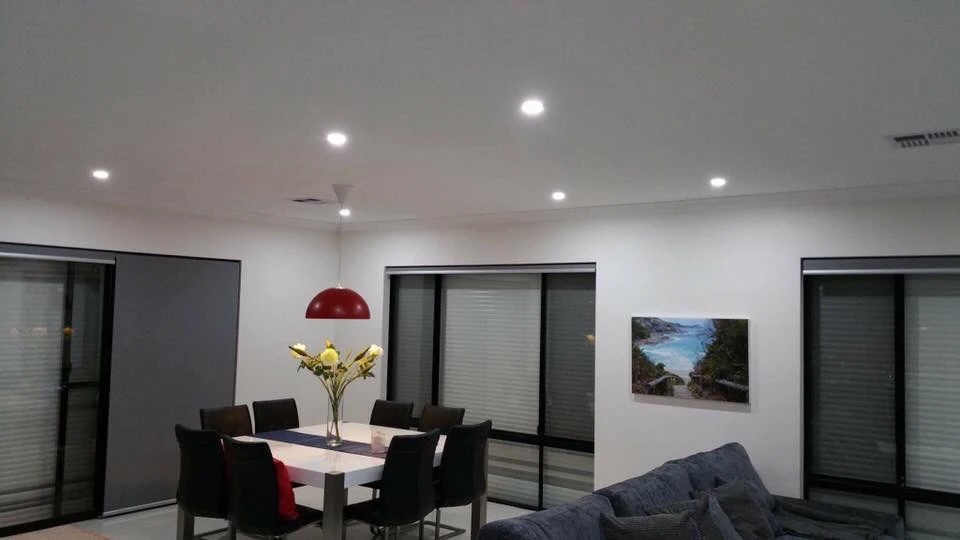
Perth renovations follow a predictable pattern. A homeowner decides to upgrade from a single ceiling rose and pendant light to LED downlights. They ask how many they need. Someone (a builder, a friend, a YouTube video) tells them more is better. They end up with 12 downlights in a 4x4 metre bedroom, a ceiling that looks like an airport runway, and a power bill that has not dropped as much as they expected.
Then they call us and ask why.
The answer involves lumens, lux, insulation ratings, hole counts, and a few things that most people installing downlights have never heard of. This post covers all of it, drawn from the same advice we give clients across our electrical work in Perth every week.
The Question to Ask Before Counting Downlights
Before anyone starts counting fittings, the right question is: what is this room actually used for?
A bedroom is a sleeping space. You need enough light to move around safely, find clothes and read. It does not need to be as bright as a surgery. A kitchen bench is a task area where you are cutting and cooking. A living room needs to work for watching TV, reading and conversation, ideally on a dimmer so it can do all three.
Most over-lit Perth homes have the same number of downlights in every room regardless of what the room is for. That is the real problem. It is not the fittings themselves, it is the assumption that more is always better.
From experience, a well-lit bedroom in a standard Perth home needs far fewer downlights than people expect. The same goes for hallways, which you walk through rather than work in. Kitchens do need more light, but the ceiling is often the wrong place to put it for the bench area specifically.
Why LED Downlights Cost Less to Run
The saving per fitting is simple arithmetic. The halogen downlights most Perth homes used to have draw 35W or 50W each. An LED downlight that replaces one draws 7 to 10W, which is roughly 70% to 85% less power for the same fitting. Twenty downlights switched on together fall from 700 to 1,000W to 140 to 200W.
LEDs also run much cooler. Halogen downlights run hot and need a clear zone around them, which is why the insulation rating of a fitting matters, as the next two sections explain.
What Every 90mm Hole Actually Costs You
This is the part most conversations about downlights miss.
Every downlight requires a 90mm hole cut into your ceiling. In a Perth home with ceiling insulation, which is most homes built after 2000 and plenty of older ones that have been upgraded, that hole is a gap straight through it.
The mechanism is straightforward. Ceiling insulation works by creating a continuous barrier that slows heat transfer between your conditioned living space and the roof cavity. Perth summers push roof cavity temperatures to 60-70°C on hot days. Every gap in the insulation, including every downlight hole, gives that heat a path into your living space.
Research by BRANZ (the Building Research Association of New Zealand) found that a 4mm gap in ceiling insulation results in a 50% loss in insulation performance for that section. A 90mm downlight hole is considerably larger than 4mm.
Multiply that by 20 downlights across a house and you have a real reduction in how well your insulation works, so the air conditioner works harder, runs longer and costs more to run. The LED savings on your lighting circuit can be partially or fully offset by increased air conditioning load.
IC Ratings: What They Mean and Why They Matter
Not all LED downlights are equal when it comes to insulation. The IC rating tells you how a fitting interacts with ceiling insulation:
Non-IC (also marked CA): must have insulation kept at least 200mm clear in all directions. Every non-IC fitting creates a significant uninsulated zone in your ceiling. These should never be installed in an insulated ceiling and are increasingly difficult to source for good reason.
IC-2: insulation can be brought to the edge of the fitting but not placed over it. Better than non-IC but still leaves a thermal gap at the fitting position.
IC-4: insulation can be placed directly over the fitting. This is the standard we specify on all downlight installations. With IC-4 rated fittings, the insulation remains continuous and the thermal breach is minimised to the hole itself rather than a 200mm exclusion zone around it. Always follow the fitting instructions: for example, HPM IC-4 downlights need insulation rated to at least 90°C and are not suitable for loose-fill insulation (HPM datasheet).
The difference between a room full of non-IC downlights and IC-4 downlights in insulation terms is significant, especially in Perth, where summer roof spaces get extremely hot.
When quoting a downlight installation we always ask about existing insulation and specify IC-4 rated fittings as standard. It costs marginally more per fitting but the energy performance difference over the life of the installation makes it the only sensible choice in a Perth climate.
The Draft Problem Nobody Talks About
Heat transfer through insulation gaps is one issue. Air movement is another.
A downlight hole with a standard fitting is not airtight. Hot air from the roof cavity can move through gaps around the fitting into the living space, and cooled air from the room can escape the other way into the roof cavity, where it is wasted.
On a hot Perth day with the air conditioner running, this creates a continuous exchange of conditioned air and hot roof air through every downlight fitting in the ceiling. The more fittings, the more exchange, the harder the air conditioner works.
IC-4 rated fittings with a sealed housing address this. The better quality IC-4 fittings have a continuous housing that minimises air movement around the fitting. Cheaper fittings, even some sold as IC-4, have gaps around the driver housing that let air through.
This is one reason why the cheapest downlight on the shelf is rarely the most cost-effective choice over a five-year period.
Colour Temperature: Getting This Wrong Makes Rooms Uncomfortable
Separate from the quantity question, colour temperature is the most common source of dissatisfaction we hear from clients after a downlight installation someone else did.
LED downlights are available in a range of colour temperatures measured in Kelvin:
- 2700K: very warm white, similar to old incandescent bulbs. Comfortable for bedrooms and living areas, can make kitchens feel dim
- 3000K: warm white. The most versatile and most commonly specified for residential. Works well in living areas, bedrooms, bathrooms, and kitchens
- 4000K: neutral white. Good for kitchens, bathrooms, laundries, garages. Starts to feel clinical in living and sleeping areas
- 5000K-6500K: cool white to daylight. Appropriate for workshops, some commercial applications. Uncomfortable for prolonged residential use in living areas
Perth builders often specify 5000K or 6500K throughout a house because it photographs well and looks bright in a display home. Living in it is a different experience. A bedroom lit with 6500K cool white downlights does not help anyone sleep, and the research on light colour and sleep is clear on this.
Our standard recommendation for Perth homes: 3000K throughout living areas, bedrooms, and bathrooms, with 4000K optional in kitchens and laundries where task lighting clarity is more important than warmth.
Dimmers: the Right Approach to the Over-Lit Room
If you already have more downlights than you need, or want one room to do different jobs, dimmers are the practical answer.
For control from your phone or by schedule, see smart switches for Perth homes. For a garage or workshop, where the light has to suit the work, see the Martin car detailing studio.
A dimmer allows you to run the lights at 30-40% output for ambient evening use and 100% for task-oriented use. This saves energy, extends fitting life significantly (LED fittings run cooler and longer when dimmed), and allows you to adjust the light level to suit the activity.
Not all LED downlights are dimmable, so check the specifications before buying. And not all dimmers are compatible with all LED drivers. Pairing the wrong dimmer with an LED fitting causes flicker, buzzing, and premature driver failure. We specify the dimmer and fitting together to ensure compatibility rather than leaving the client to mix and match. If you are looking at other energy-saving upgrades at the same time, our piece on DC ceiling fans covers another easy win for Perth homes.
A Practical Room-by-Room Guide
These are the numbers we typically arrive at for standard Perth homes with 2.4m ceilings, using quality 800-900 lumen IC-4 rated fittings. Every house is different, but these give you a realistic starting point:
- Bedroom 3x3m: 2 to 3 downlights. Add a bedside lamp for reading rather than more ceiling fittings. You sleep in this room. It does not need to be bright.
- Bedroom 4x4m: 4 downlights. Not 10, not 12. Four well-placed fittings light the room properly. If it feels dim, the fitting output or placement is wrong, not the count.
- Living room 5x4m: 6 downlights on a dimmer circuit. Supplement with a floor lamp or pendant for atmosphere in the evening. The dimmer does more for a living room than extra fittings.
- Kitchen 4x3m: 4 general downlights plus dedicated under-cabinet lighting for the benchtop. Do not try to light the bench from the ceiling. The angle is wrong and you will always be working in your own shadow.
- Bathroom 2x2m: 2 downlights plus a mirror light. Ceiling fittings alone create unflattering shadow on the face regardless of how many you install. A mirror light at eye level solves this.
- Hallway 1x4m: 2 downlights, centred. You walk through a hallway. Two fittings is enough.
If those numbers seem low compared to what you have seen quoted elsewhere, that is the point of this post. The standard practice of filling a ceiling with a tight grid of downlights produces over-lit, uncomfortable rooms that cost more to run than they need to.
The Alternative Worth Considering: Modern LED Oyster Lights
There is a third option that rarely comes up, and it solves most of the problems above in one go.
Modern slimline LED oyster lights have come a very long way from the cheap plastic fittings that gave surface-mounted lights a bad reputation. The current generation are low-profile, well-designed, and produce excellent even light across a whole room from a single fitting, with one small hole for the cable and no gap in your ceiling insulation.
A quality 40W equivalent LED oyster in a 4x4m bedroom produces 3,000-4,000 lumens, more than enough for the space, from a single fitting that sits flush or near-flush against the ceiling. No grid of holes, no insulation gaps, no compatibility questions, and installation is straightforward.
The practical advantages over downlights in the right rooms:
- Zero insulation impact: one small cable entry point versus multiple 90mm holes
- Even light distribution: no hot spots or dark corners between downlight positions
- Lower installation cost: one fitting, one connection, versus multiple fittings and longer cable runs
- Better for retrofits: can replace an existing ceiling rose with no additional ceiling work
- Modern designs available: slim profiles, CCT switchable, dimmable options, and clean aesthetics that suit contemporary Perth homes
Oyster lights are not right for every room. A kitchen benchtop benefits from the directional light of downlights, and some architectural spaces really do suit a recessed look. But for bedrooms, hallways, laundries, and secondary living spaces, a well-chosen LED oyster is often the smarter decision than drilling a grid of holes and dealing with the insulation consequences.
When we quote a downlight installation, we will always mention the oyster option if it makes sense for the space. Sometimes the best lighting solution involves fewer holes, not more.
If you are planning a downlight installation or thinking about upgrading existing fittings, we can discuss the rooms, insulation situation and the outcome you want before preparing a scope. See our Perth electrical services for lighting, power, data, safety work and more.
Planning an LED Lighting Upgrade?
Tell us which rooms you are updating and what you want the lighting to do. Dextel can help you plan a practical electrical lighting scope for your home or business.
Discuss Your Lighting → Electrical services →